This Post Contains Affiliate Links. Please Read Our Disclosure for Full Information.
Is your toddler starting to say their first words, babbling nonstop, or pointing at everything instead of telling you what they want? You’re in such an exciting stage of parenting!
Watching your little one learn to communicate is magical, but figuring out how to encourage those early words can feel confusing.
The good news? You don’t need expensive classes or complicated learning activities to support your toddler’s speech development.
Simple everyday activities like reading books, singing songs, playing pretend, and talking during daily routines can help build communication skills naturally.
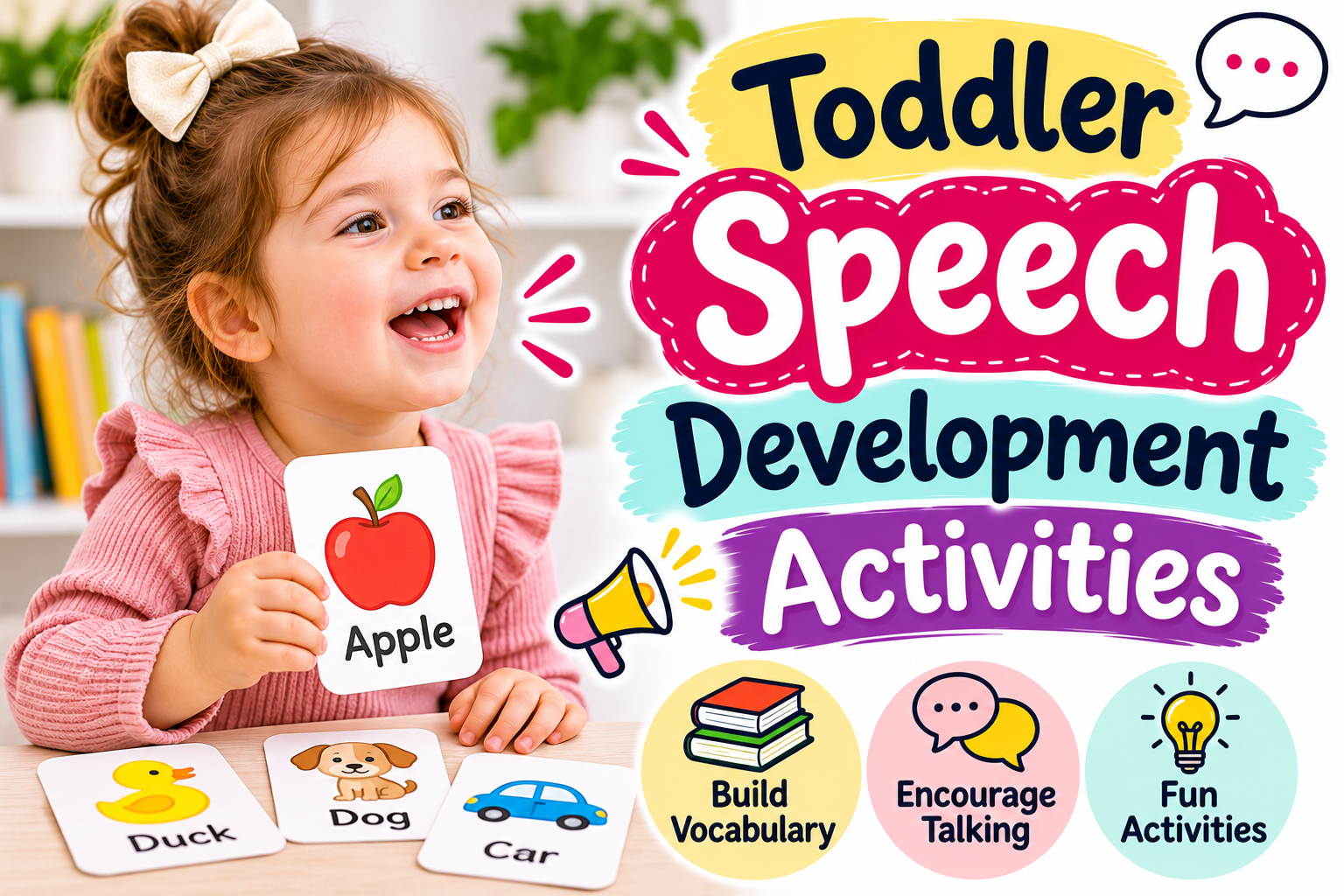
These 25 toddler speech development activities are fun, easy to try at home, and perfect for turning everyday playtime into learning opportunities.
Let’s help those little voices grow, one giggle and word at a time! 💛
1. Read Picture Books Together
Picture books are one of the easiest ways to introduce new words.
Choose books with colorful pictures of animals, foods, vehicles, and everyday objects. Point to the pictures, name what you see, and give your toddler time to respond with a sound, gesture, or word.
Shop toddler first words picture books on Amazon.


✨ Parenting Tip: Instead of reading every sentence, follow your toddler’s interests and talk about the pictures they notice.
2. Play Animal Sound Games
Who knew pretending to be a cow could be such a fun learning activity? 🐮
Use toy animals or picture cards and make simple sounds like “moo,” “baa,” and “woof.” Let your toddler watch your mouth and encourage them to join in without pressuring them to repeat.
Shop toddler farm animal toys on Amazon.

✨ Parenting Tip: Celebrate attempts at sounds, gestures, or words rather than expecting perfect pronunciation.
3. Sing Nursery Rhymes with Actions
Songs are wonderful for introducing rhythm, repetition, and familiar words.
Sing simple nursery rhymes while clapping, waving, or moving your hands. Pause at predictable moments to give your toddler a chance to join in with a movement or sound.
Shop toddler nursery rhyme board books on Amazon.

✨ Parenting Tip: Repeat your toddler’s favorite songs regularly so they become familiar and easier to participate in.
4. Practice Naming Everyday Objects
Your home is basically one giant language-learning playground!
During everyday routines, name familiar objects like cups, shoes, spoons, and blankets. Use short sentences such as “Here’s your cup” or “Let’s put on your shoes.”
Shop toddler everyday object flashcards on Amazon.

✨ Parenting Tip: Focus on natural conversation rather than constantly asking your toddler to identify or repeat objects.
5. Play with Toy Cars and Trucks
Toy cars can turn ordinary playtime into a fun communication activity.
Roll a car across the floor while saying words like “go,” “stop,” “fast,” and “beep beep.” Take turns pushing vehicles and narrating what happens.
Shop toddler toy cars and trucks on Amazon.

✨ Parenting Tip: Pause before rolling the car again to create a natural opportunity for your toddler to gesture, make a sound, or say “go.”
6. Use Puppets for Simple Conversations
Puppets can make talking feel playful and exciting.
Use a soft hand puppet to say hello, ask simple questions, and act out everyday situations. Your toddler can respond by waving, smiling, making sounds, or using words.
Shop toddler hand puppets on Amazon.

✨ Parenting Tip: Give your puppet a funny voice and use short, repetitive phrases to keep the interaction engaging.
7. Play Peekaboo with Simple Words
Peekaboo isn’t just adorable. It’s also a wonderful opportunity for back-and-forth communication.
Hide your face behind your hands and say “Where’s Mommy?” before revealing your face with an excited “Peekaboo!”
Let your toddler take turns hiding and revealing their face.
Shop peekaboo board books for toddlers on Amazon.

✨ Parenting Tip: Pause before saying “peekaboo” and watch whether your toddler anticipates the next part.
8. Practice Body Part Names
Learning body part names can be a fun part of everyday routines.
Point to your nose, ears, hands, and feet while naming them. Use a doll or stuffed animal to make the activity more playful.
Shop toddler body parts learning books on Amazon.

✨ Parenting Tip: Try naming body parts during bath time or while getting dressed instead of turning the activity into a quiz.
9. Play Pretend Kitchen Games
Pretend cooking is such a fun way to introduce everyday vocabulary.
Use toy food, plates, and cups to act out making breakfast or preparing dinner. Model simple phrases like “Cut apple,” “More soup,” and “Yummy food.”
Shop toddler pretend kitchen food sets on Amazon.

✨ Parenting Tip: Follow your toddler’s pretend-play ideas and add a few words to describe what they’re doing.
10. Use Bubble Play to Encourage Communication
Bubbles are practically toddler magic! 🫧
Blow bubbles while using simple words like “pop,” “up,” “more,” and “big.” Pause between turns so your toddler can communicate that they want another round.
Shop toddler bubble blowing toys on Amazon.

✨ Parenting Tip: Accept pointing, signing, or vocalizing as communication. Adults should handle bubble solution and supervise closely.
11. Practice Simple Choice Questions
Giving your toddler choices creates natural opportunities to communicate.
Hold up two familiar objects and ask, “Apple or banana?” or “Blue cup or red cup?” Let your child respond by pointing, looking, gesturing, or speaking.
Shop toddler choice picture cards on Amazon.

✨ Parenting Tip: Start with two clear options and model the chosen word naturally after your toddler responds.
12. Play with Building Blocks
Building blocks are perfect for introducing action words and simple descriptions.
Stack blocks together while saying “up,” “more,” “big,” and “fall down.” Let your toddler knock down the tower and enjoy the excitement.
Shop large toddler building blocks on Amazon.

✨ Parenting Tip: Describe what your toddler is doing instead of asking too many questions. Choose large, age-appropriate blocks.
13. Try a Toy Telephone Conversation
Ring, ring! Your toddler has an important call to make. 📞
Use a pretend telephone to model greetings like “Hello,” “Hi Grandma,” and “Bye-bye.” Take turns holding the phone and having silly conversations.
Shop toddler pretend telephones on Amazon.

✨ Parenting Tip: Let your toddler lead the conversation, even if their side is mostly babbling.
14. Use a Mirror for Silly Face Games
Toddlers love looking at themselves, especially when funny faces are involved.
Sit together in front of a child-safe mirror and make exaggerated smiles, surprised expressions, and silly sounds. Name emotions like “happy” and “surprised” as you play.
Shop shatter-resistant toddler mirrors on Amazon.

✨ Parenting Tip: Keep the activity playful rather than asking your toddler to copy specific mouth movements perfectly.
15. Create a Simple Picture Matching Game
Picture matching games introduce familiar vocabulary while encouraging attention and interaction.
Choose large picture cards featuring animals, foods, or household objects. Place two or three cards in front of your toddler and help them find matching pictures.
Shop toddler picture matching cards on Amazon.

✨ Parenting Tip: Name each picture naturally and keep the game short enough that your toddler stays interested.
16. Talk During Snack Time
Snack time is a perfect opportunity for everyday language learning.
Describe the foods your toddler is eating using simple words like “crunchy,” “sweet,” “banana,” and “more.” Talk about what you’re doing as you prepare and serve the snack.
Shop toddler snack plates on Amazon.

✨ Parenting Tip: Encourage communication naturally, but never withhold food or pressure your toddler to speak before eating. Always supervise meals.
17. Play with Baby Dolls
Pretend baby care introduces everyday words and simple action phrases.
Use a baby doll to act out feeding, dressing, sleeping, and bathing. Model phrases like “Baby sleeps,” “Wash baby,” and “Night-night.”
Shop toddler baby dolls on Amazon.

✨ Parenting Tip: Expand on what your toddler says. If they say “baby,” you might respond, “Yes, baby is sleeping!”
18. Go on a Nature Naming Walk
A simple walk outside can become an exciting vocabulary adventure.
Point out trees, birds, flowers, cars, and other interesting things you see. Use short descriptions such as “big tree,” “red flower,” and “bird flying.”
Shop toddler nature picture books on Amazon.

✨ Parenting Tip: Follow whatever catches your toddler’s attention instead of trying to teach a long list of words.
19. Play Simple Action Games
Movement and language make such a fun combination!
Use simple instructions like “Clap hands,” “Jump,” “Wave,” and “Sit down.” Demonstrate each action and join your toddler as they play.
Shop toddler action activity cards on Amazon.

✨ Parenting Tip: Start with familiar actions and celebrate participation, whether your toddler responds with movement, sounds, or words.
20. Make a Family Photo Naming Book
Toddlers often love looking at pictures of people they know.
Create a small photo book featuring parents, grandparents, siblings, and other familiar family members. Look through it together and talk about the people in each picture.
Shop personalized toddler photo books on Amazon.

✨ Parenting Tip: Use the names and family terms your toddler hears at home, including words from all the languages your family speaks.
21. Play a Simple Hide-and-Find Game
Hide a favorite toy under a cloth or behind a cushion and encourage your toddler to find it.
Use simple phrases like “Where’s teddy?” “Look under!” and “You found it!”
This playful activity creates opportunities to introduce location words and take turns communicating.
Shop toddler hide-and-seek toys on Amazon.

✨ Parenting Tip: Start with easy hiding spots and make the game more challenging only when your toddler is ready.
22. Practice Talking During Bath Time
Bath time is full of everyday words your toddler can learn through play.
Talk about pouring water, washing hands, and floating bath toys. Use short phrases like “Water goes down,” “Wash feet,” and “Duck floats.”
Shop toddler bath toys on Amazon.

✨ Parenting Tip: Keep bath toys simple and supervise your toddler within arm’s reach at all times. Never leave a child alone in the bath.
23. Use Repetitive Storytelling Games
Toddlers often enjoy hearing the same story again and again, and repetition can support language learning.
Choose a simple picture book with predictable phrases. Read it several times, then pause before a familiar word or sound to invite your toddler to participate.
Shop repetitive toddler storybooks on Amazon.

✨ Parenting Tip: Give your toddler plenty of time to respond, and continue the story warmly even if they don’t fill in the missing word.
24. Create a Pretend Grocery Store
Turn your living room into a tiny grocery store using play food and a shopping basket.
Take turns being the shopper and cashier while using simple phrases like “Buy apple,” “More milk,” and “Thank you.”
This activity introduces useful vocabulary through imaginative play.
Shop toddler pretend grocery store sets on Amazon.

✨ Parenting Tip: Use large, age-appropriate pretend foods without detachable small pieces that could pose a choking hazard.
25. Practice Everyday Conversations During Playtime
One of the most effective ways to support your toddler’s communication is simply talking and responding during everyday play.
Sit together with their favorite toys and describe what they’re doing. If your toddler points to a ball, you might say, “Ball! You want the red ball!”
Let the conversation flow naturally through sounds, gestures, and words.
Shop toddler interactive learning toys on Amazon.

✨ Parenting Tip: Follow your toddler’s lead, pause often, and respond warmly to every attempt at communication.
How to Encourage Toddler Speech Development at Home
You don’t need to schedule hours of learning activities every day. A few simple habits can make everyday communication more meaningful.
- Talk throughout daily routines: Describe what you’re doing during meals, dressing, and playtime.
- Respond to gestures and sounds: Pointing, waving, and babbling are all meaningful forms of early communication.
- Expand your toddler’s words: If they say “car,” you can respond with “Yes, a big car!”
- Read and sing together: Repetition helps toddlers become familiar with words and phrases.
- Give your toddler time to respond: Avoid rushing to fill every quiet moment.
- Limit passive screen time: Prioritize real conversations, shared play, and face-to-face interaction.
- Use your family’s languages: Speaking the languages you’re most comfortable with gives your child rich opportunities to communicate.
When Should You Be Concerned About Toddler Speech Development?
Every child develops at their own pace, but some communication milestones can help you understand when to seek additional guidance.
| Age | Examples of Communication Milestones |
|---|---|
| Around 12 months | Waves goodbye and uses a special name for a parent |
| Around 15 months | Tries to say one or two words besides familiar parent names |
| Around 18 months | Tries to say three or more words besides familiar parent names and follows simple one-step directions |
| Around 2 years | Says at least two words together, such as “more milk” |
| Around 3 years | Has back-and-forth conversations with at least two exchanges and is understood by others most of the time |
These are examples of CDC developmental milestones, not diagnostic tests or strict deadlines. Children may reach individual skills at different times.
If your toddler is not meeting expected milestones, has difficulty understanding language, seems not to hear well, or loses skills they previously had, talk with your pediatrician. A hearing evaluation and speech-language assessment may be helpful. You don’t need to wait for a particular birthday to ask for support.
Final Thoughts
Supporting your toddler’s communication doesn’t have to involve expensive toys, complicated lessons, or constant practice.
These 25 toddler speech development activities show how simple moments like reading books, singing songs, playing pretend, and talking during everyday routines can create wonderful opportunities for language learning.
The secret is to make communication fun, follow your toddler’s interests, and celebrate every little attempt to connect.
Whether your child is using gestures, babbling, saying their first words, or starting to put sentences together, those everyday interactions matter.
So grab a favorite picture book, build a silly block tower, sing that nursery rhyme for the hundredth time, and enjoy connecting with your little one.
Because some of the sweetest parenting memories begin with the tiniest little words. 💕✨