This Post Contains Affiliate Links. Please Read Our Disclosure for Full Information.
Is there anything sweeter than hearing your toddler say a new word for the first time? One minute they’re babbling away, and the next they’re pointing at the family dog and proudly saying, “Doggy!”
Watching your little one’s language skills grow is such an exciting part of parenting. And the best part? You don’t need expensive classes or complicated learning activities to encourage toddler language development.
Simple everyday moments like reading books, singing songs, playing pretend, and talking during snack time can create wonderful opportunities for communication.
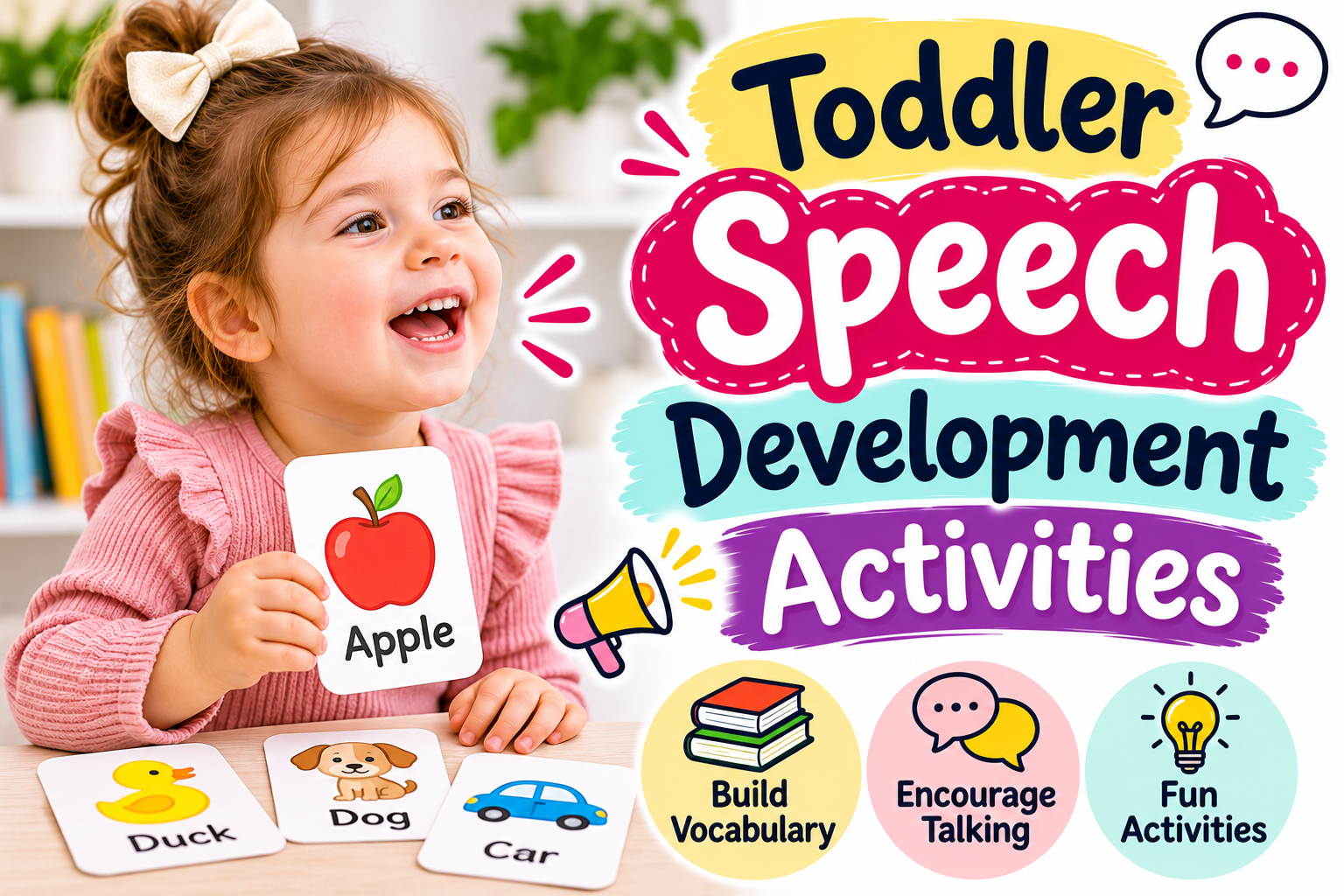
Whether your toddler is just beginning to say words or already putting together little sentences, these 23 language development activities for toddlers are fun, easy, and perfect for practicing at home.
Let’s turn everyday playtime into little language-learning adventures! 💛
1. Read Colorful Picture Books Together
Reading is one of the easiest ways to introduce your toddler to new words.
Choose colorful picture books featuring familiar animals, foods, toys, and everyday objects. Point to pictures, name what you see, and encourage your child to participate.
If your toddler points to a dog, you might say, “Yes, a dog! The dog is running!”
✨ Parenting Tip: Let your toddler choose the book and turn the pages. Keeping reading interactive is more important than finishing every sentence.
Explore toddler picture books.


2. Play the Name That Object Game
Turn everyday objects into a simple language-learning game.
Gather a few familiar items, such as a spoon, cup, ball, and toy car. Hold up each object, say its name, and give your toddler a chance to respond.
You can also ask, “Where’s the ball?” and encourage your child to point or pick it up.
✨ Parenting Tip: Start with just two or three familiar objects and gradually introduce new vocabulary as your toddler becomes comfortable.
Try toddler first words flashcards.

3. Sing Nursery Rhymes With Hand Movements
Music makes language practice feel like playtime!
Sing familiar nursery rhymes such as Twinkle, Twinkle, Little Star or The Wheels on the Bus while using simple hand movements.
The repetition gives your toddler opportunities to recognize words, sounds, and patterns.
Pause occasionally and see whether your child wants to fill in a word or gesture.
✨ Parenting Tip: Sing slowly, use exaggerated facial expressions, and repeat your toddler’s favorite songs often.
Explore toddler nursery rhyme books.

4. Practice Animal Sounds With Toy Animals
Animal sounds are a fun way to encourage toddlers to experiment with speech.
Gather a few toy animals and make their sounds together.
You might say, “The cow says moo!” or “The duck says quack!”
Let your toddler copy the sounds, point to the animals, or make up their own silly noises.
✨ Parenting Tip: Accept approximations and gestures as meaningful communication instead of insisting on perfect pronunciation.
Shop toddler farm animal toys.

5. Create a Pretend Grocery Store
Toddlers love copying what grown-ups do, and pretend shopping creates plenty of opportunities for language.
Set up a little grocery store using play food, baskets, and a toy cash register.
Take turns being the shopper and cashier while using simple phrases like “I want apples” or “Here’s your milk.”
✨ Parenting Tip: Model short phrases that are just slightly longer than what your toddler currently says.
Try a toddler pretend grocery store playset.

6. Use Puppets for Simple Conversations
Sometimes toddlers are more interested in talking to a silly puppet than answering grown-up questions. And honestly, who can blame them? 😄
Use a hand puppet to say hello, ask simple questions, and describe everyday activities.
You can make the puppet say, “I’m hungry!” and invite your toddler to pretend to feed it.
✨ Parenting Tip: Keep conversations playful and give your child plenty of time to respond with words, gestures, or sounds.
Shop hand puppets for toddlers.

7. Play a Simple Picture Matching Game
Picture matching games can help toddlers connect words with familiar objects.
Choose cards featuring animals, fruits, vehicles, or household items.
Name each picture and encourage your child to find a matching card or object.
Keep the activity short and celebrate their participation rather than focusing on getting every match correct.
✨ Parenting Tip: Begin with a few clear pictures and introduce more only when your toddler seems interested.
Explore toddler picture matching games.

8. Narrate Everyday Routines
You don’t need to schedule a special activity to support language development.
Simply talk about what you’re doing throughout the day.
While getting dressed, say, “Let’s put on your socks. One sock, two socks!” During lunch, describe the food’s color, taste, or texture.
These little conversations help connect words with familiar experiences.
✨ Parenting Tip: Use short, natural sentences and leave pauses so your toddler has opportunities to participate.
Try toddler daily routine picture cards.

9. Play With a Toy Kitchen and Pretend Food
A pretend kitchen is basically a tiny language-learning playground.
Encourage your toddler to prepare imaginary meals, name ingredients, and serve food to stuffed animals.
Use simple phrases like “Cut the banana,” “Stir the soup,” or “The food is hot!”
You can also introduce words such as more, empty, full, and finished.
✨ Parenting Tip: Follow your child’s pretend-play ideas instead of directing every part of the activity.
Shop toddler pretend kitchen food sets.

10. Encourage Two-Choice Conversations
Offering choices gives your toddler a meaningful reason to communicate.
Hold up two items and ask, “Do you want the red cup or the blue cup?”
Your child might respond by pointing, saying a color, or attempting a short phrase.
Acknowledge their choice and model the words naturally.
✨ Parenting Tip: Start with two clearly different options and avoid repeatedly asking your toddler to say the answer.

11. Build and Describe With Blocks
Building blocks are great for practicing words related to colors, sizes, positions, and actions.
Stack a few blocks together and describe what you’re doing.
Say things like “Big tower!” “Blue block on top!” or “Uh-oh, it fell!”
Invite your toddler to choose the next block or help knock down the tower.
✨ Parenting Tip: Repeat useful words such as up, down, more, big, and fall during play.
Shop large building blocks for toddlers.

12. Explore a First Words Picture Book
A first words book can introduce vocabulary through simple, familiar pictures.
Sit together and explore pages featuring food, clothing, animals, toys, and vehicles.
Instead of asking your toddler to name everything, point to pictures and talk about them.
For example, “That’s a banana. We ate a banana this morning!”
✨ Parenting Tip: Connect pictures to real objects whenever possible to make new words more meaningful.
Shop first 100 words books for toddlers.

13. Play the Where Is It? Game
This simple game helps toddlers practice understanding everyday words and directions.
Hide a favorite toy under a blanket or behind a cushion and ask, “Where’s teddy?”
When your toddler finds it, celebrate with phrases like “You found teddy!” or “Teddy was under the blanket!”
Use different locations to introduce position words.
✨ Parenting Tip: Start with easy hiding spots and gradually introduce words like under, behind, inside, and next to.
Try soft stuffed animals for toddlers.

14. Practice Body Part Names With a Doll
Dolls and stuffed animals make learning body-part vocabulary fun and interactive.
Point to the doll’s nose, ears, hands, and feet while naming each one.
Then invite your toddler to find the same body parts on themselves.
You can turn it into a silly game by asking, “Where are teddy’s toes?”
✨ Parenting Tip: Introduce a few body parts at a time and repeat them naturally during dressing and bath time.
Shop soft baby dolls for toddlers.

15. Make a Family Photo Talking Book
Toddlers love looking at familiar faces!
Create a simple photo book featuring family members, pets, and favorite places.
Point to each picture and talk about who’s there and what they’re doing.
You might say, “That’s Grandma!” or “Look, Daddy is holding the dog!”
✨ Parenting Tip: Include photos of familiar daily activities to introduce action words like eating, sleeping, running, and playing.
Try a toddler family photo album.

16. Play With Toy Cars and Action Words
Toy cars are perfect for introducing action words in a fun, natural way.
Roll cars across the floor and describe what happens.
Say “Go!” as the car moves, “Stop!” when it pauses, and “Fast car!” when it zooms across the room.
You can also build simple ramps or pretend roads.
✨ Parenting Tip: Pause before saying a familiar action word and see whether your toddler wants to join in.
Shop large toddler toy cars.
17. Practice Simple Directions With a Ball
A soft ball can turn language practice into a fun movement activity.
Sit facing your toddler and roll the ball back and forth.
Use simple directions like “Roll the ball,” “Give it to me,” or “Put it in the basket.”
As your child becomes comfortable, introduce slightly longer directions.
✨ Parenting Tip: Pair your words with gestures initially, then gradually reduce the gestures if your toddler understands the activity.

18. Create a Simple Story With Picture Cards
Storytelling doesn’t have to involve complicated plots or long sentences.
Choose a few picture cards showing familiar characters, animals, or activities.
Arrange them in a simple sequence and tell a short story together.
For example, “The dog is hungry. The dog eats. Now the dog is happy!”
✨ Parenting Tip: Let your toddler point, gesture, or add words to the story. There’s no need to correct every detail.
Shop toddler sequencing picture cards.

19. Practice Describing Colors During Play
Colors are everywhere, making them easy to introduce during everyday activities.
Gather a few colorful toys and describe them while playing.
Say, “You have a red car!” or “Let’s put the yellow block on top.”
You can also sort objects by color if your toddler enjoys matching games.
✨ Parenting Tip: Focus on natural exposure rather than expecting your toddler to identify every color correctly.
Try toddler color sorting toys.

20. Play Pretend Doctor With Stuffed Animals
Pretend doctor play creates opportunities for words related to feelings, body parts, and everyday actions.
Use a toy doctor kit and let your toddler check a stuffed animal.
You might say, “Teddy has a cough,” “Let’s listen to his heart,” or “Teddy feels better!”
Keep the activity playful and follow your child’s interests.
✨ Parenting Tip: Choose age-appropriate pretend medical toys without small detachable pieces that could be choking hazards.
Shop toddler pretend doctor kits.

21. Play the Finish the Sentence Game
Once your toddler becomes familiar with certain phrases, try pausing before the final word.
For example, say, “Ready, set…” and wait to see whether your child says or gestures “Go!”
You can also use familiar songs, nursery rhymes, and daily routines.
The anticipation makes this activity especially fun.
✨ Parenting Tip: Give your toddler several seconds to respond, and continue naturally even if they don’t fill in the word.
Try interactive toddler sound books.

22. Explore Sensory Words With Texture Toys
Language development isn’t only about naming objects. Describing how things feel is important too!
Gather safe toddler-friendly materials with different textures, such as soft fabric, a smooth ball, or a textured sensory toy.
Describe each one using words like soft, rough, smooth, squishy, and bumpy.
Let your toddler explore while you talk about what they notice.
✨ Parenting Tip: Supervise sensory play and avoid loose beads, water beads, and other small materials that could be swallowed.
Shop toddler textured sensory toys.

23. Create a Daily Talk and Play Basket
Want an easy way to encourage language development without planning a new activity every day?
Create a small basket filled with a few favorite language-friendly toys.
Include a board book, toy animal, soft ball, puppet, and picture cards.
Spend a few minutes playing together while naming objects, describing actions, and responding to your toddler’s communication.
✨ Parenting Tip: Rotate a few items every week to keep playtime interesting without overwhelming your child.
Shop toddler learning activity baskets.

Best Language Development Activities by Skill
Different activities offer opportunities to practice different communication skills.
| Language Skill | Activities to Try |
|---|---|
| Learning new words | Picture books, naming objects, first words books |
| Understanding directions | Ball games, hiding toys, pretend play |
| Practicing speech sounds | Animal sounds, nursery rhymes, playful imitation |
| Using short phrases | Pretend grocery store, toy kitchen, puppets |
| Building descriptive vocabulary | Texture play, color sorting, building blocks |
| Taking turns in conversation | Puppets, pretend doctor, ball rolling |
| Storytelling | Family photo books, sequencing cards |
| Everyday communication | Daily routines, offering choices, talk and play basket |
Remember: Toddlers develop communication skills at different rates. The goal isn’t to turn playtime into a test—it’s to create enjoyable opportunities for interaction.
Simple Daily Routine for Encouraging Toddler Language Development
You don’t need an hour-long lesson plan to encourage communication.
Here’s an easy way to include language-rich activities throughout your day.
| Time | Simple Activity |
|---|---|
| Morning | Name clothing and body parts while getting dressed |
| Breakfast | Offer choices and describe foods |
| Mid-morning | Read a picture book together |
| Playtime | Practice action words with blocks or toy cars |
| Lunch | Talk about colors, textures, and familiar foods |
| Afternoon | Sing nursery rhymes or play pretend |
| Evening | Look at family photos and talk about the day |
| Bedtime | Read a favorite story and repeat familiar phrases |
Even a few minutes of responsive, back-and-forth interaction throughout the day can create meaningful opportunities for language learning.
7 Easy Ways to Encourage Your Toddler to Talk More
Along with these activities, a few everyday habits can help support your toddler’s communication.
- Follow your toddler’s interests. Talk about whatever they’re already looking at or playing with.
- Give them time to respond. Pause instead of immediately answering for them.
- Expand their words. If your toddler says “car,” respond with “Yes, a big red car!”
- Use gestures and facial expressions. These help make communication meaningful.
- Repeat useful words naturally. Repetition gives toddlers more opportunities to hear and understand language.
- Avoid pressuring them to perform. Keep communication relaxed instead of repeatedly asking them to say specific words.
- Enjoy face-to-face play. Responsive interaction is more valuable than passive exposure to videos or talking toys.
If your family speaks more than one language, keep using the languages you’re comfortable speaking. Multilingual exposure does not itself cause a language disorder.
Frequently Asked Questions About Toddler Language Development
What are the best language development activities for toddlers?
Reading picture books, singing songs, pretend play, naming familiar objects, and having back-and-forth conversations are excellent everyday activities.
The most helpful activities are usually the ones your toddler enjoys and wants to repeat.
How can I encourage my 2-year-old to talk more?
Talk during everyday routines, offer simple choices, expand on your child’s words, and allow time for responses.
If you’re concerned about your child’s speech or language development, speak with their pediatrician or a speech-language pathologist rather than relying only on home activities.
Do flashcards help toddlers learn language?
Flashcards can be useful when used interactively, but they aren’t necessary for language development.
Real-life conversations, shared reading, and playful interactions provide important opportunities to connect words with meaningful experiences.
Should I correct my toddler when they pronounce words incorrectly?
You usually don’t need to correct every pronunciation mistake.
Instead, model the word naturally. If your toddler says “wawa,” you might respond, “Yes, you want water!”
Can toddlers learn two languages at the same time?
Yes! Toddlers can learn more than one language.
Using multiple languages at home does not cause speech or language disorders. Children may distribute their vocabulary across languages, so consider their communication skills in all languages they use.
When should I worry about my toddler’s speech development?
Consider seeking professional guidance if your toddler isn’t meeting expected communication milestones, has difficulty understanding language, rarely uses gestures, or loses previously acquired skills.
For example, by around 24 months, many children are combining at least two words. Milestones are guides rather than diagnoses, but concerns deserve timely attention.
A pediatrician can discuss hearing evaluation and referral to a speech-language pathologist or early intervention services when appropriate.
How much time should I spend on language activities every day?
There’s no required amount of time for formal language activities.
Short, enjoyable interactions throughout meals, playtime, reading, and daily routines can be more manageable than long structured sessions.
Final Thoughts
Helping your toddler develop language skills doesn’t have to involve complicated lessons, expensive learning toys, or perfectly planned activities. 💛
Sometimes, the most meaningful learning happens while you’re reading a favorite book, building a block tower, singing a silly song, or chatting during snack time.
These 23 language development activities for toddlers are designed to make communication fun, natural, and part of your everyday routine.
Remember that every toddler develops at their own pace, and communication includes much more than spoken words. Gestures, pointing, facial expressions, listening, and turn-taking are all important.
Celebrate the little moments, follow your child’s interests, and keep the pressure off.
Because those tiny conversations you’re having today are helping build the foundation for so many wonderful conversations in the future. 🥹
Save these toddler language development activities to your Pinterest Toddler Learning Activities board so you’ll always have fun, easy communication ideas ready for playtime.
Happy talking, playing, and learning together! ✨