This Post Contains Affiliate Links. Please Read Our Disclosure for Full Information.
The kitchen is one of the best places to teach kids practical life skills, and they don’t even need to cook! From organizing groceries to setting the table, everyday kitchen tasks can build independence, confidence, and responsibility.
These 25 kitchen life skills activities for kids beyond cooking use simple household supplies to turn ordinary routines into valuable hands-on learning experiences.
1. Practice Setting the Dinner Table
Setting the table is a wonderful first kitchen responsibility for young children.
Give your child a placemat, lightweight plate, cup, napkin, and child-safe utensils. Show them where each item belongs and let them practice arranging everything independently.
Younger kids can start with just a plate and spoon, while older children can learn more complete place settings.
✨ Parenting Tip: Use a picture placemat showing where each item goes to make the activity easier for beginners.
Shop kids table setting placemats.

2. Sort and Organize Kitchen Utensils
Sorting kitchen utensils helps children develop organization skills while learning about everyday household tools.
Place clean, child-safe spoons, forks, and other utensils on a table. Ask your child to group matching items and return them to the correct drawer compartments.
This simple activity also supports sorting, categorization, and attention to detail.
✨ Parenting Tip: Start with spoons and other blunt utensils. Keep sharp knives, peelers, and other hazardous tools out of reach.
Shop adjustable kitchen drawer organizers.


3. Learn How to Wash Hands Properly
Handwashing is an essential kitchen life skill that children can practice every day.
Teach your child to wet their hands, apply soap, scrub for at least 20 seconds, rinse thoroughly, and dry with a clean towel.
Practice before meals, after using the bathroom, and after handling anything dirty.
✨ Parenting Tip: Sing a short handwashing song to help younger children understand how long to scrub.
Shop kids bathroom step stools.

4. Practice Pouring Water Into Cups
Pouring water helps children develop hand-eye coordination, concentration, and independence.
Fill a small, lightweight pitcher with a little water and provide two sturdy cups. Show your child how to hold the pitcher with both hands and pour slowly.
Practice over a tray to catch spills and make cleanup easier.
✨ Parenting Tip: Begin with small amounts of water and use unbreakable cups until your child becomes more confident.
Shop kids small water pitchers.

5. Match Food Storage Containers With Lids
Matching containers and lids is a practical activity that also strengthens problem-solving skills.
Gather several clean plastic food containers in different shapes and sizes.
Separate the lids and encourage your child to find the correct match for each container.
Older children can organize the containers by size before storing them neatly.
✨ Parenting Tip: Choose lightweight containers without damaged edges and keep plastic bags or small detachable parts away from younger children.
Shop plastic food storage containers.

6. Learn to Wipe Kitchen Tables
Cleaning the table is a simple way to introduce responsibility and everyday hygiene.
Give your child a clean, damp microfiber cloth and demonstrate how to wipe the table from one side to the other.
Encourage them to check for crumbs and spills before putting the cloth in the laundry.
This activity builds coordination and helps children understand shared household responsibilities.
✨ Parenting Tip: Use plain water for beginner cleaning activities and keep household cleaning chemicals securely stored.
Shop microfiber cleaning cloths.

7. Sort Groceries Into Categories
Putting away groceries can become a fun sorting activity.
Choose safe, lightweight grocery items and ask your child to group them into categories such as fruits, vegetables, canned goods, and pantry staples.
Explain which foods belong in the refrigerator and which can be stored in cupboards.
This helps children understand basic food organization.
✨ Parenting Tip: Let younger children sort unbreakable items on a table while adults handle heavy, fragile, or refrigerated groceries.
Shop reusable grocery storage baskets.

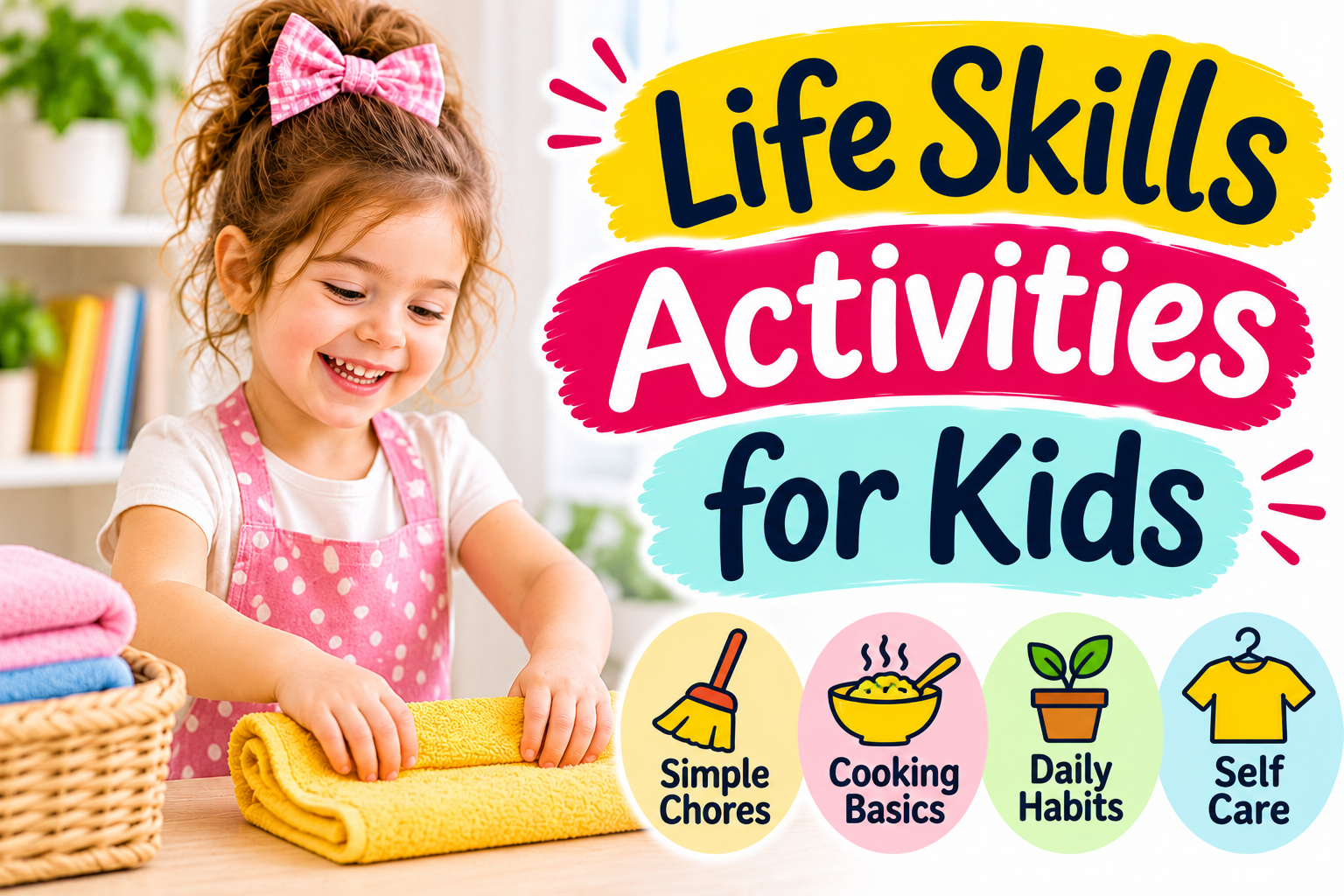
8. Practice Folding Kitchen Towels
Folding kitchen towels is an easy activity that introduces children to basic household organization.
Provide several clean dish towels and demonstrate how to fold them in half, then fold them again.
Let your child stack the folded towels neatly in a drawer or basket.
Younger children can practice simple folds while older kids work on making tidy, matching stacks.
✨ Parenting Tip: Start with small towels because they’re easier for little hands to manage.
Shop cotton kitchen dish towels.

9. Learn to Load the Dishwasher Safely
Loading the dishwasher is a useful responsibility for older children who can follow safety instructions.
Start by showing them how to place lightweight, dishwasher-safe cups and plates in the correct sections.
Explain why items need enough space for water to circulate.
Adults should handle sharp utensils, breakable dishes, detergent, and any hot items.
✨ Parenting Tip: Begin with clean dishes during practice sessions before introducing the real household routine.
Shop unbreakable kids dinnerware sets.

10. Practice Opening and Closing Food Containers
Opening and closing containers helps children develop fine motor skills needed for everyday independence.
Gather clean containers with different child-friendly lids, including snap-on and twist-top designs.
Show your child how each container opens and closes.
This is especially useful for children learning to manage their own lunchboxes.
✨ Parenting Tip: Choose large, easy-grip containers and avoid small caps or detachable pieces that could become choking hazards.
Shop easy open lunch containers for kids.

11. Organize a Snack Drawer
Creating a kid-friendly snack drawer can help children practice organization and decision-making.
Choose a low drawer or shelf and fill it with a small selection of parent-approved snacks.
Use baskets to separate different categories and show your child how to return items neatly.
This encourages independence while keeping snack choices manageable.
✨ Parenting Tip: Include only age-appropriate foods and follow safe storage guidelines. Adults should supervise eating and decide when snacks are offered.
Shop small pantry drawer organizers.

12. Learn Basic Kitchen Safety Rules
Understanding kitchen safety is an important life skill that children can begin learning early.
Walk around the kitchen together and identify areas that require adult help, such as the stove, oven, sharp utensil drawers, and electrical appliances.
Use simple language to explain why certain objects should not be touched.
Practice asking an adult before using unfamiliar kitchen tools.
✨ Parenting Tip: Create a small picture chart showing safe activities and tasks that require adult supervision.
Shop kids kitchen safety visual cards.

13. Practice Sweeping Kitchen Crumbs
Sweeping helps children build coordination while learning to care for shared spaces.
Give your child a child-sized broom and dustpan, then sprinkle a few large paper scraps on a clean floor.
Demonstrate how to sweep the pieces into a pile and collect them with the dustpan.
Once they’re comfortable, they can help clean ordinary crumbs after meals.
✨ Parenting Tip: Use paper scraps for practice and avoid sharp objects, broken glass, or unknown spills.
Shop kids broom and dustpan sets.

14. Sort Recyclable Materials
Recycling is a valuable kitchen responsibility that teaches children about caring for the environment.
Gather clean, dry, safe packaging materials such as cardboard boxes and plastic containers.
Show your child how to separate items according to your local recycling rules.
Use labeled bins with pictures to make sorting easier.
✨ Parenting Tip: Adults should handle sharp cans, broken materials, and containers that held hazardous substances.
Shop small recycling sorting bins.

15. Learn to Read Simple Food Labels
Food labels provide a fun opportunity to introduce practical reading and observation skills.
Choose familiar packaged foods and point out the product name, pictures, ingredients, and date markings.
Younger children can identify colors and symbols, while older kids can practice reading simple information.
Explain that food labels help families understand what they’re buying and eating.
✨ Parenting Tip: Keep the activity age-appropriate and focus on curiosity rather than labeling foods as “good” or “bad.”
Shop kids magnifying glasses.

16. Practice Carrying a Tray
Carrying a tray helps children develop balance, concentration, and careful movement.
Start with a lightweight tray holding one or two unbreakable, empty cups.
Ask your child to carry it slowly from one table to another.
As their confidence grows, you can add lightweight items or a small amount of water.
✨ Parenting Tip: Keep the walking path clear and avoid hot drinks, glass containers, or heavy objects.
Shop lightweight serving trays.

17. Organize Pantry Shelves
Pantry organization teaches children how to group household supplies and maintain tidy spaces.
Give your child a small collection of lightweight pantry items and ask them to arrange similar products together.
They might place cereal boxes in one section and unopened snack packages in another.
Older children can help check labels and identify items that should be used soon.
✨ Parenting Tip: Keep heavy cans, glass jars, and other potentially hazardous items on shelves managed by adults.
Shop clear pantry storage baskets.

18. Practice Using Napkins Properly
Using napkins is a small but meaningful everyday life skill.
Demonstrate how to place a napkin on the lap, wipe hands and mouth gently, and dispose of or fold it after eating.
You can practice during pretend meals using toy dishes.
This helps children become more comfortable with basic table manners.
✨ Parenting Tip: Model the behavior during family meals instead of repeatedly correcting your child’s mistakes.
Shop washable cloth napkins.

19. Learn to Pack a Lunchbox
Packing a lunchbox helps children develop planning and organization skills.
Provide a clean lunchbox and several parent-approved food containers.
Let your child practice arranging the containers so everything fits neatly.
Older children can help choose balanced lunch options with adult guidance.
✨ Parenting Tip: Teach children to close containers securely and use an insulated lunch bag with appropriate cold packs for perishable foods.
Shop kids compartment lunch boxes.

20. Practice Cleaning Up Small Spills
Learning how to respond to spills helps children become more confident and responsible.
Pour a little water onto a washable tray and demonstrate how to absorb it using a cloth.
Encourage your child to wipe from the outside toward the center and place the damp cloth in the laundry afterward.
This simple activity also builds problem-solving skills.
✨ Parenting Tip: Practice only with clean water. Adults should handle hot liquids, broken glass, and chemical spills.
Shop reusable cleaning cloths.

21. Match Plates, Cups, and Bowls
Matching kitchen items is a fun way to combine practical life skills with early learning.
Gather unbreakable plates, bowls, and cups in different colors or sizes.
Ask your child to group matching items or arrange them into pretend place settings.
This supports sorting, visual discrimination, and everyday organization skills.
✨ Parenting Tip: Begin with matching colors before introducing more challenging categories such as size and shape.
Shop colorful kids dinnerware sets.

22. Learn How to Check a Grocery List
A grocery list introduces children to planning, observation, and simple household decision-making.
Create a short picture-based shopping list with familiar items such as apples, bread, milk, and cereal.
Let your child check off items as they’re placed in the shopping cart or unpacked at home.
Older children can practice reading written lists.
✨ Parenting Tip: Keep the list short and allow children to participate without making shopping feel like a test.
Shop kids reusable checklist boards.

23. Practice Arranging a Dish Drying Rack
Putting away clean dishes is an excellent way to practice organization.
Provide a few clean, unbreakable cups, plates, and bowls.
Show your child how to place them carefully in a dish drying rack so they remain stable.
This helps children understand how kitchen items are stored after washing.
✨ Parenting Tip: Use only lightweight, cool, unbreakable items and keep sharp utensils and fragile dishes for adults.
Shop compact dish drying racks.

24. Learn to Follow a Kitchen Cleanup Checklist
A simple checklist helps children understand the steps involved in cleaning up after a meal.
Create a picture chart showing tasks such as taking dishes to the counter, wiping the table, putting away napkins, and checking the floor for crumbs.
Let your child mark each completed step.
This encourages independence and helps build consistent routines.
✨ Parenting Tip: Choose only two or three tasks for younger children and gradually add responsibilities as they grow.
Shop kids chore checklist charts.

25. Create a Kid-Friendly Kitchen Responsibility Station
A dedicated kitchen responsibility station can bring several life skills together.
Choose a low shelf or small basket and fill it with safe supplies such as a microfiber cloth, lightweight placemats, napkins, and a simple picture checklist.
Show your child how to use each item and return it after completing a task.
This makes everyday kitchen responsibilities easier to remember.
✨ Parenting Tip: Keep the station free from sharp tools, cleaning chemicals, and other hazards. Rotate tasks as your child’s abilities develop.
Shop small kitchen storage baskets.

Kitchen Life Skills Activities by Age
Every child develops at their own pace, so choose activities based on individual abilities and the level of supervision required.
| Age Group | Suggested Activities | Skills Practiced |
|---|---|---|
| Ages 2–3 | Matching containers, folding small towels, sorting unbreakable dishes | Matching, coordination, early independence |
| Ages 3–4 | Setting the table, wiping with water, sorting groceries | Responsibility, organization, fine motor skills |
| Ages 4–5 | Pouring water, packing practice lunchboxes, sorting recyclables | Concentration, planning, coordination |
| Ages 5–6 | Organizing pantry items, following cleanup charts, preparing table settings | Independence, sequencing, organization |
| Ages 7+ | Reading food labels, checking grocery lists, helping load dishwasher-safe items | Planning, problem-solving, household responsibility |
These are flexible age suggestions, not strict developmental milestones. Always supervise kitchen activities and adjust tasks to your child’s abilities.
How to Teach Kitchen Life Skills Without Cooking
You don’t need a complicated lesson plan to help children develop practical kitchen skills.
Start with everyday routines. Invite your child to help with simple tasks you already do, such as setting the table or putting away groceries.
Demonstrate one step at a time. Show your child how to complete a task slowly before encouraging them to try.
Choose child-sized supplies. Lightweight pitchers, small cloths, and easy-grip containers can make activities more manageable.
Use picture checklists. Visual reminders help younger children understand routines without needing to read.
Allow extra time. Children often work more slowly than adults, and that’s a normal part of learning.
Encourage effort over perfection. A slightly crooked placemat or unevenly folded towel is still progress.
Keep safety a priority. Supervise children, secure hazardous items, and avoid assigning tasks involving hot surfaces, sharp tools, or cleaning chemicals.
Benefits of Teaching Kitchen Life Skills to Kids
Kitchen activities offer much more than help with household chores.
- Build independence: Children gain confidence by completing simple everyday responsibilities.
- Improve fine motor skills: Pouring, folding, sorting, and opening containers strengthen coordination.
- Develop problem-solving abilities: Matching lids, organizing shelves, and following checklists encourage logical thinking.
- Teach responsibility: Helping maintain shared spaces introduces the importance of teamwork.
- Support early learning: Sorting, counting, categorizing, and reading labels connect everyday tasks with foundational academic skills.
- Encourage family participation: Simple kitchen responsibilities give children opportunities to contribute meaningfully.
Final Thoughts
The kitchen is full of learning opportunities that go far beyond preparing meals. 💛
From setting the table and sorting groceries to organizing cupboards and cleaning up spills, these 25 kitchen life skills activities for kids beyond cooking can help children develop confidence, independence, and practical everyday skills.
You don’t need expensive equipment or complicated activities to get started.
Choose one simple task, demonstrate it patiently, and give your child opportunities to practice.
Remember, the goal isn’t perfect results. It’s helping children feel capable, responsible, and included in family routines.
Little kitchen helpers today, confident independent kids tomorrow—one simple skill at a time! ✨