This Post Contains Affiliate Links. Please Read Our Disclosure for Full Information.
Creating a Montessori-inspired play area doesn’t require a big playroom! With a low shelf, thoughtfully arranged toys, and a little creativity, even a small apartment or bedroom can become an inviting learning space.
These 17 Montessori toy shelf setup ideas for small spaces will help you organize toys, encourage independent play, and keep your home clutter-free.
1. Choose a Low Wooden Montessori Toy Shelf
A low wooden shelf is a wonderful starting point for a Montessori-inspired play area.
Choose a sturdy, child-height shelf that allows your little one to see and reach toys independently. Arrange a few activities with enough space between them so the shelf doesn’t look overcrowded.
Natural wood finishes also blend beautifully with most home decor styles.
Shop low Montessori toy shelves on Amazon.


✨ Montessori Tip: Choose a shelf with rounded edges and secure it according to the manufacturer’s anti-tip instructions.
2. Create a Montessori Shelf in a Bedroom Corner
An unused bedroom corner can become a cozy Montessori play area without taking up much space.
Place a compact wooden shelf against the wall and add a small washable rug in front of it.
Display a few favorite activities, such as stacking toys, wooden puzzles, and picture books.
Shop small Montessori toy shelves on Amazon.

✨ Montessori Tip: Keep the play area simple and avoid placing too many toys in one corner.
3. Use a Two-Tier Montessori Shelf
A two-tier shelf is ideal for small spaces because it provides accessible storage without becoming too tall.
Arrange larger toys on the bottom shelf and smaller activity trays on the upper level.
This setup helps children see their choices clearly and makes cleanup easier.
Shop two-tier Montessori shelves on Amazon.

✨ Montessori Tip: Leave some empty space between activities so children can easily remove and return each item.
4. Create a Minimalist Montessori Toy Shelf
A minimalist Montessori shelf focuses on a small selection of meaningful activities rather than displaying every toy.
Choose a simple wooden shelf and arrange four to six age-appropriate toys, depending on your child’s interests and abilities.
Include activities that encourage problem-solving, movement, creativity, and exploration.
Shop minimalist wooden toy shelves on Amazon.

✨ Montessori Tip: Rotate toys based on your child’s interests instead of adding more toys whenever the shelf looks empty.
5. Use Montessori Activity Trays
Activity trays are a practical way to organize small toys and learning materials.
Place one activity on each tray, such as a simple puzzle, sorting game, or matching activity.
Arrange the trays neatly on a low shelf so children can select and carry them to their play area.
Shop Montessori activity trays on Amazon.

✨ Montessori Tip: Use lightweight trays with easy-to-grip edges and choose activities without small parts for children who still mouth objects.
6. Create a Montessori Shelf Beside a Reading Nook
Combine a small toy shelf with a cozy reading area to create a multifunctional learning space.
Place a low shelf beside a floor cushion or small reading mat.
Dedicate one section to picture books and the remaining shelves to simple toys and activities.
Shop Montessori bookshelves for toddlers on Amazon.

✨ Montessori Tip: Display a few books with their covers facing forward to make choosing a story easier.
7. Use a Small Cube Organizer as a Montessori Shelf
A compact cube organizer can work as an affordable Montessori-inspired toy shelf.
Choose a low, stable organizer with open compartments and arrange toys where your child can reach them.
Use a few shallow baskets for loose items while keeping favorite activities visible.
Shop small cube toy organizers on Amazon.

✨ Montessori Tip: Anchor the organizer securely and avoid stacking cube units where children could climb them.
8. Create a Montessori Toy Shelf in the Living Room
You don’t need a separate playroom to create a beautiful Montessori-inspired setup.
Place a low wooden shelf along an empty living room wall and choose storage that complements your existing furniture.
Display a few wooden toys, books, and activity trays to keep the area inviting without overwhelming the room.
Shop living room Montessori toy shelves on Amazon.
✨ Montessori Tip: Keep the shelf away from television cords, unstable furniture, and other household hazards.
9. Use Small Baskets for Montessori Toy Organization
Small baskets help keep toy shelves organized while making activities easy to carry.
Choose lightweight baskets for blocks, soft toys, or larger puzzle pieces.
Arrange them neatly on open shelves and avoid overfilling each basket.
Shop Montessori toy storage baskets on Amazon.

✨ Montessori Tip: Use one basket per activity so children can understand where each toy belongs.
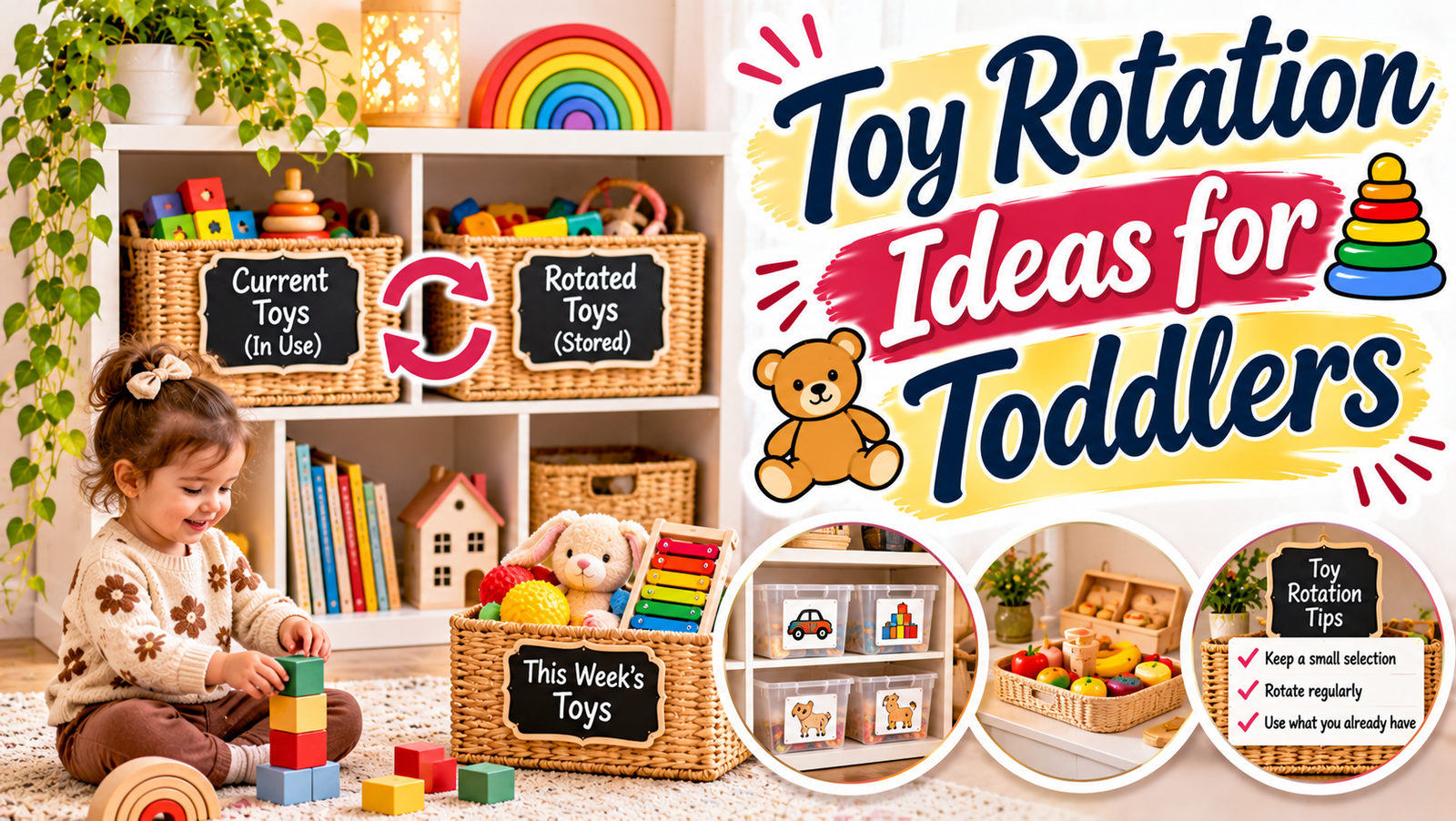
10. Create a Montessori Shelf with a Toy Rotation System
Toy rotation is especially useful in small homes where storage space is limited.
Display a few activities on your child’s shelf and store the remaining toys in a separate closed container.
Rotate items when your child loses interest or needs a new challenge.
Shop toy rotation storage bins on Amazon.

✨ Montessori Tip: Observe which activities your child enjoys before changing the shelf. There’s no need to rotate toys on a strict schedule.
11. Use a Narrow Montessori Shelf for Small Apartments
A narrow Montessori shelf is ideal for apartments with limited floor space.
Choose a slim, low bookshelf that fits along a short wall or beside existing furniture.
Arrange a small collection of toys, puzzles, and books without blocking walkways.
Shop narrow Montessori toy shelves on Amazon.

✨ Montessori Tip: Measure the available space before buying furniture and leave enough room for children to sit and play comfortably.
12. Create a Montessori Shelf with Practical Life Activities
Practical life activities are an important part of Montessori-inspired learning.
Dedicate one section of the shelf to simple, age-appropriate activities such as folding cloths, matching socks, or transferring large objects between containers.
These activities encourage coordination, concentration, and everyday independence.
Shop Montessori practical life activity sets on Amazon.

✨ Montessori Tip: Use child-safe materials and avoid small beads, dried beans, or other choking hazards for young children.
13. Use a Montessori Shelf with Open Display Compartments
Open compartments allow children to see available activities without opening drawers or storage boxes.
Choose a low shelf with wide, accessible spaces and display each toy separately.
This setup can make toy selection easier and support independent cleanup.
Shop open Montessori toy shelves on Amazon.
✨ Montessori Tip: Keep each compartment simple rather than filling every available inch with toys.
14. Create a Montessori Shelf with Natural Materials
Natural materials can create a calm, inviting Montessori-inspired play environment.
Choose wooden shelves, cotton baskets, and age-appropriate toys made from wood or other durable materials.
Pair the setup with a neutral rug to create a cozy play area.
Shop natural wooden Montessori toys on Amazon.

✨ Montessori Tip: Check wooden toys for splinters, loose pieces, and damaged finishes before offering them to children.
15. Create a Montessori Shelf Under a Window
The space beneath a bedroom or playroom window can be useful for a low toy shelf.
Choose a compact shelf that fits comfortably below the windowsill.
Arrange a few learning activities and add a small play mat nearby.
Natural daylight can make the space feel bright and welcoming.
Shop low wooden toy storage shelves on Amazon.
✨ Montessori Tip: Avoid this location if the shelf could provide access to a window. Keep furniture away from blind cords and unsecured windows.
16. Create a Montessori Shelf with a Small Play Mat
A small play mat helps define a dedicated activity area without requiring a separate room.
Place a low Montessori shelf against the wall and add a washable mat in front of it.
Encourage children to bring one activity onto the mat and return it to the shelf when finished.
Shop Montessori play mats for toddlers on Amazon.

✨ Montessori Tip: Choose a nonslip mat with enough room for your child to sit and work comfortably.
17. Create a Multifunctional Montessori Toy Shelf Setup
For very small homes, a multifunctional Montessori shelf can combine toys, books, and activity materials in one organized space.
Choose a sturdy low shelf with open compartments.
Dedicate one section to books, another to puzzles, and the remaining spaces to practical life activities or building toys.
This keeps everything accessible while reducing the need for extra furniture.
Shop multifunctional Montessori toy shelves on Amazon.
✨ Montessori Tip: Arrange the most frequently used activities at the easiest-to-reach height and keep heavier items on lower shelves.
How to Set Up a Montessori Toy Shelf in a Small Space
Creating a Montessori-inspired toy shelf is easier when you focus on accessibility, simplicity, and organization.
Follow these steps:
- Choose a suitable location: Look for an unused corner, bedroom wall, or small living room area.
- Select a low, sturdy shelf: Choose furniture that your child can access comfortably and that can be secured against tipping.
- Start with a few activities: Display approximately four to six activities, adjusting for your child’s age and interests.
- Organize one activity per space: Use trays, baskets, or open compartments.
- Keep toys visible: Avoid overcrowding shelves or hiding everything in opaque containers.
- Create a comfortable play area: Add a washable rug or small activity mat.
- Rotate toys thoughtfully: Introduce different activities when your child is ready for something new.
- Encourage independent cleanup: Show your child how to return activities to their designated places.
- Prioritize safety: Check furniture stability, toy suitability, and nearby household hazards regularly.
Best Montessori Shelf Activities by Age
| Age Group | Suggested Shelf Activities | Learning Focus |
|---|---|---|
| 6–12 months | Soft sensory toys, large grasping toys, sturdy board books | Sensory exploration and grasping |
| 12–18 months | Large stacking toys, simple object permanence activities, chunky puzzles | Coordination and problem-solving |
| 18–24 months | Large shape sorters, simple matching activities, stacking cups | Fine motor skills and concentration |
| 2–3 years | Beginner puzzles, large building blocks, practical life activities | Independence and coordination |
| 3–4 years | Sorting games, counting activities, matching cards | Early math and classification |
| 4–5 years | More complex puzzles, sequencing activities, age-appropriate practical life work | Problem-solving and independence |
These are general developmental suggestions. Always choose toys based on your child’s individual abilities and the manufacturer’s age recommendations.
Montessori Toy Shelf Organization Tips for Small Homes
A well-organized Montessori-inspired shelf doesn’t need to contain dozens of toys.
- Keep the display simple: A smaller selection can make activities easier to choose.
- Use child-height furniture: Children should be able to access appropriate materials independently.
- Choose open storage: Visible toys encourage exploration and make cleanup easier.
- Use matching baskets: Coordinated containers create a calm, organized appearance.
- Rotate toys instead of adding more: Store extra activities out of sight until needed.
- Avoid overcrowding: Leave enough space for children to remove and return materials.
- Keep frequently used toys accessible: Arrange favorites at comfortable reaching heights.
- Use multipurpose furniture: Combine toy storage and bookshelves when space is limited.
- Follow your child’s interests: Select activities that match current skills and curiosity.
Important Montessori Shelf Safety Tips
Safety should always come first when designing a play area for babies, toddlers, and preschoolers.
- Anchor shelves and storage units securely to prevent tipping.
- Choose sturdy furniture with smooth edges and stable construction.
- Avoid placing shelves near windows, blind cords, heaters, or electrical outlets.
- Keep small objects, loose magnets, button batteries, and detachable toy parts away from young children.
- Inspect wooden toys regularly for cracks, splinters, or loose components.
- Avoid heavy storage bins that children could accidentally pull onto themselves.
- Choose toys that meet appropriate safety standards and age recommendations.
- Keep the floor clear to reduce tripping hazards.
- Supervise young children during play, especially when introducing new activities.
Final Thoughts
A Montessori-inspired play space doesn’t need to be large or expensive to support meaningful learning.
These 17 Montessori toy shelf setup ideas for small spaces show how simple furniture, thoughtful toy arrangements, and practical storage solutions can transform even the smallest corner into an inviting play area.
Whether you choose a low wooden shelf, a compact cube organizer, a cozy reading corner, or a multifunctional storage setup, the goal is to make activities accessible and manageable for your child.
The key is to keep toys organized, create a calm environment, and encourage age-appropriate independence through everyday play.
Start with a small shelf and a few thoughtfully chosen activities. You can always adjust the setup as your child grows and develops new interests.
Because sometimes the simplest play spaces create the most meaningful learning opportunities.
Happy organizing and learning! 🌿🧸✨