This Post Contains Affiliate Links. Please Read Our Disclosure for Full Information.
Learning doesn’t have to mean worksheets or expensive toys! Toddlers learn best through play, exploration, and everyday experiences. 🧸
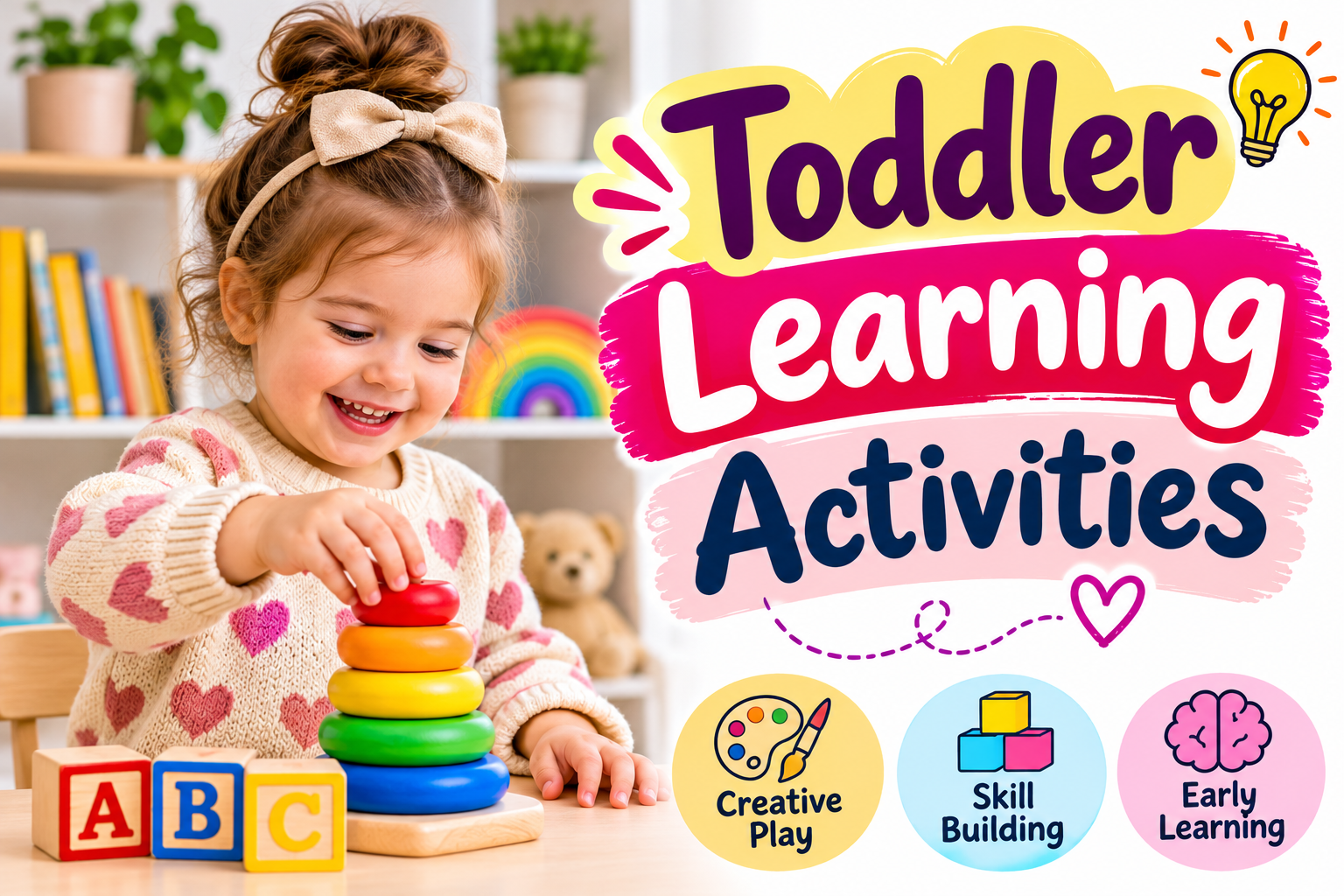
These 25 toddler learning activities you can do at home are fun, easy to set up, and perfect for developing early language, counting, motor, and problem-solving skills using simple household items.
1. Color Sorting With Everyday Objects
Color sorting is one of the easiest toddler learning activities to set up at home.
Gather large, toddler-safe objects in different colors and place matching colored containers on the floor. Encourage your toddler to sort the objects into the correct containers.
Start with just two colors before introducing more.
This activity supports early color recognition, sorting, and concentration.
✨ Learning Tip: Say each color aloud as your toddler sorts. Don’t worry if they mix things up—exploring is part of learning!
Shop toddler color sorting toys.

2. Shape Matching With Wooden Puzzles
Simple shape puzzles are wonderful for introducing circles, squares, triangles, and rectangles.
Place a few large puzzle pieces in front of your toddler and encourage them to match each shape to its corresponding space.
Let them rotate and experiment with the pieces independently.
This activity helps develop hand-eye coordination, spatial awareness, and problem-solving skills.
✨ Learning Tip: Start with puzzles containing three or four large pieces. Choose age-appropriate designs without small detachable parts.
Try wooden shape puzzles for toddlers.


3. Counting Toys Into Baskets
Turn early counting practice into a playful sorting game.
Place several large toy blocks or stuffed animals on the floor and invite your toddler to put them into a basket one at a time.
Count aloud together as each item goes inside.
Don’t expect perfect counting immediately. The goal is to introduce numbers naturally through repetition.
✨ Learning Tip: Begin with numbers one through three, then gradually introduce counting up to five as your toddler becomes interested.
Shop toddler counting toys.

4. Build Towers With Large Blocks
Building block towers is a classic toddler activity for a reason!
Give your child a collection of large, lightweight blocks and encourage them to stack the pieces into towers.
Let them experiment with balancing different shapes and sizes.
And yes, knocking the tower down is usually the most exciting part. 😅
✨ Learning Tip: Ask simple questions like, “Which block should go on top?” to encourage early problem-solving and language development.
Try large building blocks for toddlers.

5. Practice Animal Sounds With Picture Cards
Animal sounds are a fun way to encourage early language development.
Show your toddler a picture of a familiar animal and make its sound together.
Try cows, dogs, cats, ducks, and sheep before introducing less familiar animals.
Encourage your child to imitate the sounds, but don’t pressure them to repeat every word.
✨ Learning Tip: Pair animal sounds with simple actions, such as hopping like a bunny or waddling like a duck.
Shop animal flashcards for toddlers.

6. Create a Simple Sensory Bin
Sensory play encourages toddlers to explore different textures and materials.
Fill a shallow container with large, age-appropriate sensory items such as soft fabric squares, large silicone toys, or textured balls.
Let your toddler touch, squeeze, and explore the materials.
Avoid small loose fillers that could create choking hazards.
✨ Learning Tip: Introduce words such as “soft,” “bumpy,” “smooth,” and “squishy” while your toddler explores.
Try toddler sensory play toys.

7. Match Socks by Color and Pattern
Laundry time can become a surprisingly fun learning activity!
Gather several pairs of clean socks with different colors or patterns and mix them together.
Ask your toddler to find matching pairs.
This simple activity encourages visual discrimination, matching skills, and attention to detail.
✨ Learning Tip: Start with two or three clearly different pairs. As your toddler improves, add more socks with similar patterns.
Shop toddler matching games.

8. Practice Fine Motor Skills With Play Dough
Play dough is a wonderful hands-on activity for developing little hand muscles.
Give your toddler a small amount of age-appropriate, non-toxic play dough and encourage them to roll, flatten, squeeze, and press it.
Add large child-safe rollers or shape cutters for extra fun.
✨ Learning Tip: Narrate the actions using words like “roll,” “press,” and “squish.” Supervise closely and prevent your toddler from eating the dough.
Try non-toxic play dough sets for toddlers.

9. Explore Letters With Alphabet Puzzles
Toddlers can begin becoming familiar with letters through playful exposure.
Use a large-piece alphabet puzzle and let your toddler explore the different shapes.
Point to a letter, say its name, and connect it with a familiar word.
Keep the activity casual rather than expecting your child to memorize the alphabet.
✨ Learning Tip: Start with the first letter of your toddler’s name. Familiar connections often make learning more meaningful.
Shop toddler alphabet puzzles.

10. Create a Simple Indoor Obstacle Course
Movement activities are fantastic for developing coordination and body awareness.
Arrange couch cushions, soft play mats, and low obstacles to create a toddler-friendly indoor course.
Encourage your child to crawl around cushions, step over low barriers, and follow a simple path.
✨ Learning Tip: Use directional words such as “over,” “under,” “around,” and “through” to combine movement with language learning. Keep the course low and supervise throughout.
Try toddler indoor obstacle course toys.

11. Practice Pouring With Water Play
Water play introduces early science concepts while developing hand-eye coordination.
Place a shallow tray on a waterproof surface and provide two small plastic cups.
Add a little water and show your toddler how to pour from one container into another.
Expect some splashing—that’s part of the fun!
✨ Learning Tip: Use words like “full,” “empty,” “more,” and “less.” Stay within arm’s reach and never leave a toddler unattended around water, even shallow amounts.
Shop toddler water pouring toys.

12. Play a Simple Memory Matching Game
Matching games help toddlers practice concentration and visual memory.
Place two or three pairs of large picture cards face up on the floor.
Encourage your toddler to find matching images.
As they become comfortable, introduce a simple face-down matching game with just a few cards.
✨ Learning Tip: Choose familiar pictures such as animals, fruits, or everyday objects. Keep sessions short and playful.
Try toddler memory matching cards.

13. Learn Body Parts With Songs
Songs are a fun and natural way to introduce body parts.
Sing simple songs while pointing to your head, shoulders, knees, toes, hands, and feet.
Encourage your toddler to copy your movements.
This activity combines language, listening, movement, and body awareness.
✨ Learning Tip: Slow down the song and pause before naming a body part. Give your toddler time to point or respond.
Shop body parts learning toys for toddlers.

14. Sort Big and Small Objects
Understanding size differences is an important early math concept.
Gather large and small versions of similar toddler-safe toys.
Place them on the floor and encourage your child to sort them into two groups.
Use simple language such as “big ball” and “small ball.”
✨ Learning Tip: Begin with objects that have an obvious size difference. Avoid tiny objects that could fit inside your toddler’s mouth.
Try big and small sorting toys.
15. Create a Toddler Art Station
Art activities encourage creativity, hand control, and self-expression.
Set up a small table with large sheets of paper and washable, toddler-safe crayons.
Let your child scribble, draw lines, and experiment with colors.
There’s no need to create a perfect picture—the process matters more than the finished artwork.
✨ Learning Tip: Use chunky crayons that are easier for small hands to grip and supervise to prevent mouthing or chewing.
Shop washable toddler art supplies.

16. Practice Simple Puzzles Together
Puzzles help toddlers develop patience, problem-solving, and spatial awareness.
Choose chunky wooden puzzles with familiar pictures such as animals, vehicles, or fruits.
Encourage your toddler to explore where each piece belongs.
Offer gentle guidance without completing the puzzle for them.
✨ Learning Tip: Start with simple knob puzzles and gradually introduce more challenging designs as your toddler gains confidence.
Try chunky wooden toddler puzzles.

17. Explore Nature With an Indoor Nature Basket
Bring a little outdoor learning inside with a simple nature-themed activity.
Gather toddler-safe natural objects such as large leaves and oversized smooth stones, or use realistic nature toys.
Let your toddler explore different textures, colors, and shapes.
Talk about what they notice.
✨ Learning Tip: Avoid small stones, sharp objects, unknown plants, and anything that could be swallowed. Supervise all nature exploration.
Shop nature exploration toys for toddlers.

18. Practice Pretend Cooking
Pretend play helps toddlers develop imagination, language, and everyday life skills.
Set up a small play kitchen or provide toddler-safe toy pots, pans, and pretend food.
Encourage your child to cook meals, serve food, and name ingredients.
Join the fun by pretending to order breakfast!
✨ Learning Tip: Ask open-ended questions such as, “What are you making?” and “Who should we serve first?” to encourage communication.
Try toddler pretend play kitchen sets.

19. Play a Simple Follow-the-Leader Game
Follow-the-leader is an easy activity that combines listening, movement, and imitation.
Walk around the room while performing simple actions such as clapping, stomping, stretching, or waving.
Encourage your toddler to copy your movements.
Then let them become the leader!
✨ Learning Tip: Start with one action at a time before introducing short sequences. Keep movements gentle and suitable for your child’s abilities.
Shop toddler movement activity cards.

20. Match Everyday Household Objects
You don’t need expensive learning materials to practice matching skills.
Gather safe household items such as pairs of large plastic cups, washcloths, or matching containers.
Place them in front of your toddler and encourage them to find identical pairs.
This helps develop observation, categorization, and early reasoning.
✨ Learning Tip: Use familiar household objects and name each item while your toddler explores.
Try toddler object matching games.

21. Create a Simple Music and Rhythm Activity
Music is a wonderful way to encourage listening skills, coordination, and creativity.
Give your toddler age-appropriate musical instruments such as a small drum, maracas, or a toy xylophone.
Play simple rhythms and encourage them to copy the sounds.
You can also sing familiar songs together.
✨ Learning Tip: Experiment with fast, slow, loud, and quiet sounds. Choose instruments without detachable small parts.
Shop toddler musical instrument sets.

22. Practice Everyday Life Skills With Dressing Toys
Learning to dress independently is an important toddler milestone.
Use a dressing board or soft activity toy featuring large buttons, zippers, snaps, and buckles.
Encourage your toddler to practice opening and closing each fastener.
Keep the activity relaxed and celebrate small improvements.
✨ Learning Tip: Start with easy fasteners and offer help when needed. Choose age-appropriate toys without loose buttons or detachable choking hazards.
Try toddler dressing skills activity boards.

23. Explore Cause and Effect With Ball Ramps
Ball ramps introduce toddlers to simple cause-and-effect concepts.
Place a large toddler-safe ball at the top of a sturdy ramp and let your child watch it roll down.
Encourage them to repeat the activity and experiment with different starting positions.
✨ Learning Tip: Use large balls that cannot fit inside your toddler’s mouth. Talk about “fast,” “slow,” “up,” and “down” during play.
Shop toddler ball ramp toys.

24. Read Interactive Picture Books Together
Reading is one of the simplest and most valuable learning activities for toddlers.
Choose sturdy board books with colorful pictures, familiar objects, and simple stories.
Point to illustrations, name objects, and encourage your toddler to turn the pages.
Lift-the-flap books can make reading especially engaging.
✨ Learning Tip: Ask simple questions like, “Where is the puppy?” and give your toddler plenty of time to point, gesture, or respond.
Try interactive board books for toddlers.

25. Create a Daily Toddler Learning Basket
A learning basket is a simple way to keep educational play activities organized.
Choose a small basket and fill it with three or four age-appropriate activities, such as a puzzle, board book, stacking toy, and matching game.
Rotate the items regularly to maintain interest.
✨ Learning Tip: Follow your toddler’s interests rather than forcing every activity. Even five or ten minutes of engaged play can be meaningful.
Shop toddler Montessori learning toys.

Simple Daily Toddler Learning Activity Schedule
You don’t need to plan educational activities for every hour of the day. A flexible routine with short play sessions works beautifully.
| Time | Learning Activity | Skills Practiced |
|---|---|---|
| Morning | Color sorting or shape puzzles | Colors, shapes, matching |
| Mid-morning | Building blocks | Coordination, problem-solving |
| Before lunch | Picture books | Language, listening |
| Afternoon | Sensory play or art | Creativity, fine motor skills |
| Late afternoon | Indoor obstacle course | Movement, balance |
| Evening | Pretend play or music | Imagination, communication |
| Bedtime | Storytime | Vocabulary, bonding |
Remember that toddlers learn through ordinary daily experiences, too. Helping with laundry, naming foods, and exploring the backyard can all become valuable learning opportunities.
Best Toddler Learning Activities by Skill
| Developmental Skill | Recommended Activities |
|---|---|
| Fine motor skills | Play dough, puzzles, drawing |
| Gross motor skills | Obstacle courses, follow-the-leader |
| Language development | Animal sounds, picture books, pretend play |
| Early math skills | Counting toys, size sorting, shape matching |
| Problem-solving | Building blocks, ball ramps, puzzles |
| Creativity | Art activities, music, pretend cooking |
| Sensory exploration | Sensory bins, water play, nature baskets |
| Independence | Dressing toys, sorting household objects |
Tips for Making Toddler Learning Activities More Effective
A few simple habits can make everyday learning more enjoyable.
- Keep activities short: Toddlers often learn best through brief, engaging play sessions.
- Follow your child’s interests: If your toddler loves animals, incorporate animal toys, books, and sounds.
- Repeat favorite activities: Repetition helps toddlers practice and strengthen emerging skills.
- Use simple language: Describe what your child is doing with clear, everyday words.
- Encourage exploration: Allow your toddler to experiment instead of demonstrating the correct way every time.
- Avoid pressure: Learning should feel playful rather than like a test.
- Choose safe materials: Avoid choking hazards, sharp objects, loose magnets, button batteries, and activities unsuitable for your child’s developmental stage.
- Stay involved: Talking, playing, and exploring together can make activities more meaningful.
Final Thoughts
You don’t need a classroom full of educational toys to help your toddler learn and grow. 🤎
These 25 toddler learning activities you can do at home show how simple games, everyday objects, and playful experiences can support early development.
From color sorting and counting games to sensory play and pretend cooking, there are plenty of fun ways to encourage curiosity, creativity, and independence.
Start with a few activities that match your toddler’s interests and let them explore at their own pace.
Because the best learning moments often happen during the simplest everyday activities.
Which toddler learning activity are you trying first? Save these ideas for your next playtime session and enjoy making learning fun together! ✨