This Post Contains Affiliate Links. Please Read Our Disclosure for Full Information.
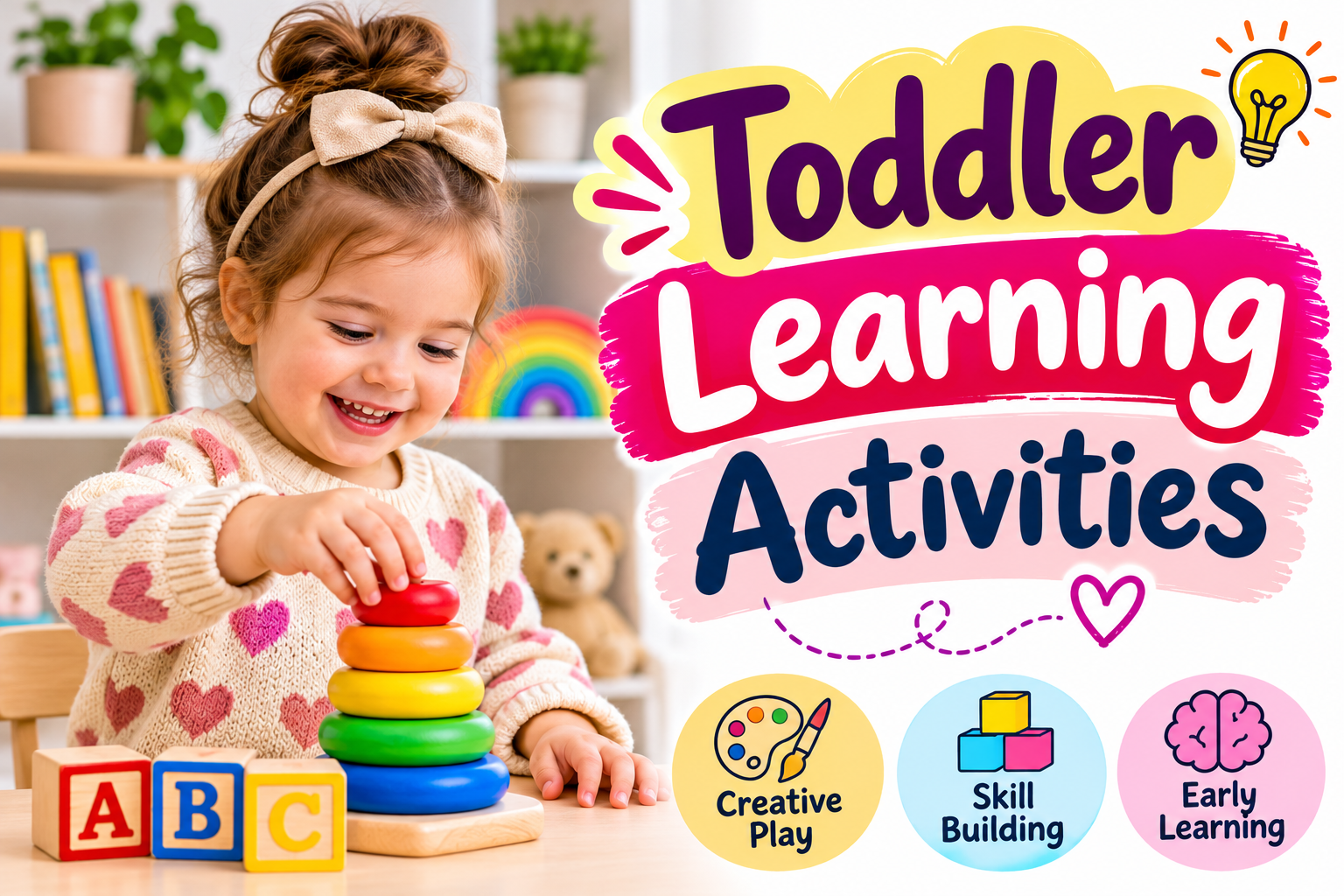
Keeping a curious 2-year-old entertained doesn’t have to mean buying expensive toys! 🧸✨ Your home is already full of simple things that can turn into exciting learning adventures.
These 21 learning activities for 2-year-olds using everyday items are easy, budget-friendly, and perfect for developing early language, motor skills, problem-solving, and creativity through play.
1. Color Sorting With Plastic Cups
Turn a few colorful plastic cups into a fun toddler sorting game!
Place three or four different-colored cups on the floor and gather matching large blocks or other toddler-safe objects.
Encourage your little one to place each object into the cup with the same color. Start with two colors if your toddler is just beginning to recognize them.
This simple activity introduces color recognition, matching, and early categorization skills.
✨ Learning Tip: Say each color aloud as your toddler sorts. Keep the game playful rather than expecting perfect matches.
Shop toddler color sorting toys on Amazon.

2. Build a Tower With Empty Cardboard Boxes
Got a few empty delivery boxes lying around? Don’t throw them away just yet!
Use small, lightweight cardboard boxes to create a toddler-friendly building activity.
Let your child stack the boxes, knock them down, and rebuild their tower.
This playful activity encourages hand-eye coordination, spatial awareness, and early problem-solving skills.
Plus, toddlers absolutely love watching towers tumble!
✨ Learning Tip: Count each box as your toddler stacks it. Remove staples, tape, and loose packaging before play.
Shop large toddler stacking blocks on Amazon.


3. Practice Counting With Large Building Blocks
You don’t need fancy educational materials to introduce your toddler to numbers.
Gather five large building blocks and place them in a row.
Count each block slowly while touching it, then encourage your toddler to copy you.
You can also ask them to hand you one block or help you make a tower with two blocks.
✨ Learning Tip: Focus on numbers one through three initially. Repetition during everyday play is more valuable than memorizing long number sequences.
Shop toddler counting blocks on Amazon.

4. Create a Shape Hunt Around the House
Your home is filled with shapes waiting to be discovered!
Walk around with your toddler and point out familiar objects such as round plates, rectangular books, and square cushions.
Encourage your child to touch or point to each shape as you name it.
You can turn the activity into a little treasure hunt by asking, “Can you find something round?”
✨ Learning Tip: Introduce one or two shapes at a time. Use everyday language like “The plate is round!” to make learning feel natural.
Shop toddler shape learning toys on Amazon.

5. Make a Simple Sensory Basket With Household Fabrics
Create a cozy sensory exploration basket using clean washcloths, soft scarves, and pieces of fabric with different textures.
Let your toddler touch each material and explore how it feels.
Use descriptive words such as soft, smooth, fluffy, and rough to introduce new vocabulary.
This activity encourages sensory awareness and language development through hands-on play.
✨ Learning Tip: Choose large, intact fabric pieces without loose threads or small decorations. Supervise closely and avoid wrapping fabric around the neck.
Shop toddler sensory fabric toys on Amazon.

6. Practice Matching With Socks
Laundry time just became learning time! 🧦
Gather several pairs of clean socks with different colors or patterns.
Mix them up and encourage your toddler to find two socks that look alike.
Start with two pairs and gradually introduce more as your child becomes comfortable.
This activity supports visual discrimination, matching, and early sorting skills.
✨ Learning Tip: Talk about the colors and patterns as your toddler matches. Celebrate their effort even when they choose the wrong pair.
Shop toddler matching games on Amazon.

7. Create a Pretend Kitchen With Plastic Bowls
Toddlers love copying everyday activities, especially cooking!
Give your little one a few clean plastic bowls, large spoons, and empty food-safe containers.
Encourage them to pretend they’re mixing soup, preparing breakfast, or serving dinner.
Pretend play helps develop imagination, language, and social understanding.
✨ Learning Tip: Narrate your toddler’s actions with simple phrases like “You’re stirring the soup!” Avoid small utensils or breakable containers.
Shop toddler pretend kitchen utensils on Amazon.

8. Practice Pouring With Plastic Cups
Pouring is a wonderful activity for developing hand-eye coordination and fine motor control.
Place two lightweight plastic cups on a tray and add a small amount of water to one.
Show your toddler how to carefully pour water from one cup into the other.
Let them experiment while you supervise.
A little spilling is completely normal!
✨ Learning Tip: Start with just a small amount of water and keep a towel nearby. Never leave toddlers unattended around water, even in shallow containers.
Shop toddler pouring activity sets on Amazon.

9. Build a Simple Indoor Obstacle Course
Turn your living room into a mini adventure playground!
Use couch cushions, rolled towels, and a few sturdy household items to create a simple obstacle course.
Encourage your toddler to step over towels, walk around cushions, and crawl through open spaces.
This activity supports balance, coordination, and body awareness.
✨ Learning Tip: Keep everything low to the ground, remove sharp or unstable objects, and supervise your toddler throughout the activity.
Shop toddler indoor obstacle course toys on Amazon.

10. Explore Big and Small With Household Objects
Introduce size comparisons using everyday items.
Gather two different-sized plastic bowls, pillows, or soft toys.
Place them side by side and explain which one is big and which one is small.
Encourage your toddler to point to the bigger object or hand you the smaller one.
This introduces early mathematical thinking through simple comparisons.
✨ Learning Tip: Use objects with an obvious size difference at first. Repeat the words “big” and “small” naturally during play.
Shop toddler size sorting toys on Amazon.
11. Create a Simple Paper Tearing Activity
Paper tearing is a surprisingly fun way to strengthen little hand muscles.
Give your toddler a few sheets of plain paper and demonstrate how to tear them into strips.
Let your child experiment with different sizes and shapes.
You can collect the pieces in a bowl and use them later for a supervised art project.
✨ Learning Tip: Use ordinary paper without staples or sharp edges. Supervise closely if your toddler still puts nonfood items in their mouth.
Shop toddler paper craft supplies on Amazon.

12. Make a Homemade Music Band
Who needs expensive musical instruments when your kitchen has everything you need?
Gather lightweight plastic containers and large wooden spoons to create a simple toddler music station.
Show your child how to tap gently on different surfaces and listen to the sounds.
Experiment with slow and fast rhythms.
This activity encourages listening skills, coordination, and creative expression.
✨ Learning Tip: Keep the volume comfortable and avoid metal, glass, or breakable containers. Use gentle tapping rather than loud banging.
Shop toddler musical instrument sets on Amazon.

13. Practice Animal Sounds With Picture Books
Grab a picture book featuring familiar animals and turn story time into a playful learning activity.
Point to each animal and make its sound.
Ask your toddler questions like “What does the cow say?” or “Can you find the dog?”
Even if your child isn’t speaking much yet, pointing and imitating sounds are meaningful ways to participate.
✨ Learning Tip: Repeat animal names and sounds slowly. Let your toddler lead the activity by choosing which pictures to explore.
Shop animal picture books for toddlers on Amazon.

14. Create a Simple Color Hunt
Turn everyday objects into a fun color recognition game.
Choose one color, such as red, and walk around the room looking for objects that match.
Your toddler might find a red cushion, a red toy, or a red book cover.
Celebrate each discovery and repeat the color name.
✨ Learning Tip: Start with one color per round and choose familiar objects. Avoid correcting every mistake—learning through exploration should feel enjoyable.
Shop toddler color recognition flashcards on Amazon.

15. Practice Fine Motor Skills With Large Pom-Poms
Large, toddler-safe pom-poms can be used for simple sorting and transferring games.
Place a few oversized pom-poms in a bowl and encourage your toddler to move them into another container using their hands.
This supports grasping, coordination, and early sorting skills.
You can also introduce color words as your toddler plays.
✨ Learning Tip: Use only oversized, securely made materials that cannot fit into your child’s mouth. Skip pom-poms entirely if your toddler mouths objects or pulls fibers loose.
Shop large toddler sensory pom-poms on Amazon.

16. Make a Simple Matching Game With Household Lids
Matching lids to containers is a wonderful little problem-solving activity.
Gather several clean plastic containers with their matching lids.
Place the lids separately and encourage your toddler to figure out which one belongs to each container.
Start with two containers that look noticeably different.
✨ Learning Tip: Choose large, lightweight containers without sharp edges or detachable small parts. Let your toddler experiment before offering help.
Shop toddler matching and sorting toys on Amazon.
17. Create a Simple Sticker Activity
Stickers can turn an ordinary sheet of paper into an exciting fine motor activity.
Give your toddler a few large, easy-peel stickers and encourage them to place each one on paper.
You can draw big circles and invite your child to place stickers inside them.
This supports finger coordination, concentration, and creativity.
✨ Learning Tip: Use large toddler-appropriate stickers and supervise closely. Avoid tiny stickers or loose backing pieces that could become choking hazards.
Shop large stickers for toddlers on Amazon.

18. Practice Body Parts With a Mirror
A child-safe mirror can become a fun learning tool for your toddler.
Sit together and point to different body parts, such as your nose, eyes, ears, and hands.
Encourage your child to find the same body parts on themselves.
Make silly faces and talk about different expressions.
✨ Learning Tip: Use an unbreakable mirror securely positioned at toddler height. Keep the activity playful and avoid expecting your child to identify every body part immediately.
Shop unbreakable toddler mirrors on Amazon.

19. Create a Pretend Grocery Store
Transform a small corner of your living room into a pretend grocery store.
Use empty, clean food boxes, large plastic containers, and a reusable shopping bag.
Let your toddler pretend to choose groceries, place them in the bag, and bring them home.
This activity supports imagination, language, and early understanding of everyday routines.
✨ Learning Tip: Use phrases like “Let’s buy apples!” or “The bag is full!” Remove staples, plastic wrapping, and any small detachable packaging pieces.
Shop toddler pretend grocery shopping toys on Amazon.

20. Practice Following Directions With a Teddy Bear
A favorite stuffed animal can make learning simple instructions much more exciting.
Place a teddy bear on the floor and give your toddler playful directions such as “Put teddy on the chair” or “Give teddy a hug.”
Start with one-step instructions before introducing simple two-step activities.
This encourages listening, comprehension, and early problem-solving.
✨ Learning Tip: Use familiar words and demonstrate the action when needed. Celebrate participation rather than turning the game into a performance test.
Shop soft teddy bears for toddlers on Amazon.

21. Create a Simple Nature Sorting Activity
Bring a little outdoor exploration into your toddler’s learning routine.
Collect a few large, clean, toddler-safe natural objects, such as broad leaves and smooth oversized stones, and place them on a tray.
Encourage your child to observe differences in color, shape, and texture.
You can sort the leaves by size or compare how the objects feel.
✨ Learning Tip: Avoid small stones, berries, mushrooms, sharp objects, and unknown plants. Supervise closely and wash hands after handling outdoor materials.
Shop toddler nature exploration kits on Amazon.

What Skills Do These Activities Help Develop?
Everyday play can support several important areas of toddler development.
| Learning Skill | Activities to Try |
|---|---|
| Color recognition | Color sorting, color hunt |
| Early counting | Counting building blocks |
| Fine motor skills | Paper tearing, stickers, pouring |
| Gross motor skills | Indoor obstacle course |
| Language development | Animal sounds, pretend grocery store |
| Problem-solving | Matching lids, building towers |
| Sensory exploration | Fabric basket, nature sorting |
| Early math concepts | Big and small comparisons |
| Imagination | Pretend kitchen, grocery store |
| Listening skills | Teddy bear directions, music play |
Remember that these activities support learning through exploration. Every child develops at their own pace, and there’s no need to turn playtime into formal lessons.
Easy Daily Learning Routine for a 2-Year-Old
You don’t need to schedule educational activities all day long.
Try adding a few short learning opportunities to your toddler’s normal routine.
| Time of Day | Simple Learning Activity |
|---|---|
| Morning | Color sorting with cups |
| After breakfast | Animal picture book |
| Midmorning | Building block play |
| Before lunch | Pretend kitchen |
| Afternoon | Indoor obstacle course |
| Late afternoon | Sticker or paper activity |
| Evening | Teddy bear directions |
| Before bed | Quiet picture book |
This is a flexible example, not a required schedule. Follow your toddler’s interests, energy level, and need for rest.
7 Tips for Making Toddler Learning Activities More Fun
1. Keep activities short. Many 2-year-olds enjoy brief activities before moving on to something new.
2. Follow your toddler’s interests. If your child loves animals, use animal pictures and pretend play to introduce new words.
3. Repeat favorite activities. Toddlers often learn through repetition, so don’t worry if they request the same game every day.
4. Use simple language. Short phrases and clear descriptions make it easier for toddlers to connect words with actions.
5. Encourage exploration. Let your child experiment instead of showing them the correct way to play every time.
6. Celebrate effort. Focus on curiosity, participation, and trying new things rather than getting perfect results.
7. Prioritize safety. Supervise activities, choose age-appropriate materials, and remove anything that could cause choking, injury, or accidental ingestion.
Frequently Asked Questions About Learning Activities for 2-Year-Olds
What should a 2-year-old be learning?
Two-year-olds are developing language, movement, social interaction, problem-solving, and early thinking skills. Everyday play, reading, conversation, and exploration can support these areas naturally.
How long should learning activities last for a 2-year-old?
There isn’t a fixed amount of time. Some toddlers enjoy an activity for several minutes, while others move on quickly. Follow your child’s interest rather than expecting them to complete a set lesson.
Can I teach my 2-year-old without educational toys?
Absolutely! Household items such as plastic cups, cardboard boxes, socks, books, and large building blocks can provide plenty of opportunities for learning.
What are the best fine motor activities for 2-year-olds?
Simple activities such as stacking blocks, pouring water, tearing paper, and placing large stickers can help toddlers practice hand and finger coordination.
How can I encourage my toddler to learn colors?
Use color words during everyday activities, such as getting dressed, sorting toys, or reading picture books. Repetition and playful exposure are more helpful than constant testing.
What if my 2-year-old isn’t interested in learning activities?
That’s completely normal. Try activities based on your child’s favorite toys or routines, keep sessions short, and allow plenty of free play. If you have concerns about developmental milestones or loss of previously learned skills, speak with your pediatrician.
Final Thoughts
You don’t need a house full of expensive educational toys to help your toddler learn and grow. 💕
These 21 learning activities for 2-year-olds using everyday items show how ordinary household objects can become opportunities for creativity, discovery, and playful learning.
From sorting colorful cups and building cardboard towers to exploring textures and playing pretend, there are so many simple ways to keep little hands busy and curious minds engaged.
Start with a few activities your toddler enjoys, keep everything relaxed, and remember that learning at this age should feel like play—not homework!
Save these easy toddler learning activities to your Pinterest toddler activities board for fun, budget-friendly inspiration whenever you need a new way to keep your little one entertained. 🧸✨