This Post Contains Affiliate Links. Please Read Our Disclosure for Full Information.
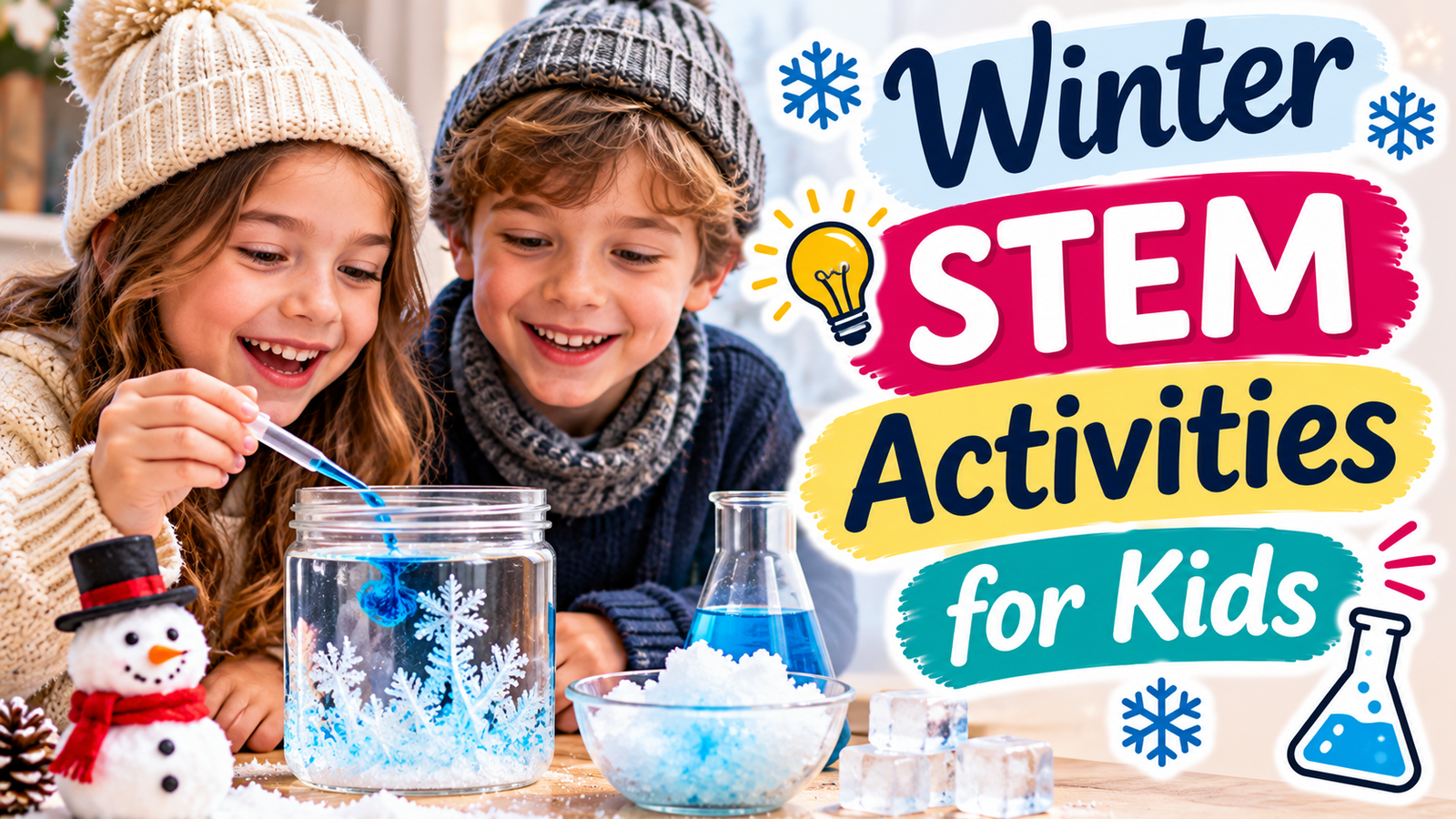
Cold winter days are perfect for hands-on learning! ❄️ These 19 indoor winter STEM challenges for elementary-age kids combine science, technology, engineering, and math through playful experiments and building activities. Using simple household supplies, children can explore problem-solving, creativity, and critical thinking while staying warm and having fun indoors.
1. Build a Marshmallow Snowflake Structure
Turn ordinary marshmallows and toothpicks into a fun winter engineering challenge.
Ask children to design and build a snowflake-shaped structure using marshmallows as connectors and toothpicks as supports.
Encourage them to experiment with different shapes and patterns while thinking about balance and symmetry.
Older elementary students can explore how triangles and other geometric shapes affect stability.
✨ STEM Challenge: Can you build a snowflake structure that stands upright without falling over?
Skills Practiced: Engineering, geometry, symmetry, and problem-solving.
Supplies: Marshmallows, toothpicks, paper, and pencils.
Safety Note: Supervise sharp toothpicks and use age-appropriate connectors when needed.
Explore marshmallow STEM building supplies.

2. Design a Paper Snowflake with Perfect Symmetry
Paper snowflakes are a wonderful way to introduce symmetry and geometric patterns.
Give children square sheets of paper and demonstrate how folding creates matching sections.
Let them cut different shapes along the folded edges before opening their designs.
Ask students to identify lines of symmetry and compare their snowflake patterns.
✨ STEM Challenge: Can you create a snowflake with at least four matching sections?
Skills Practiced: Geometry, spatial reasoning, symmetry, and design.
Supplies: Paper, child-safe scissors, rulers, and pencils.
Explore paper snowflake craft supplies.

3. Build an Igloo Using Sugar Cubes
Challenge children to design a miniature igloo using sugar cubes.
Start with a cardboard base and ask them to arrange the cubes into a circular wall.
Use a small amount of thick icing as an adhesive and gradually build upward.
Discuss why domes and curved structures are useful in certain types of construction.
✨ STEM Challenge: Can you create a stable igloo with a doorway that remains standing?
Skills Practiced: Engineering, structural design, measurement, and problem-solving.
Supplies: Sugar cubes, cardboard, icing, and a plastic spoon.
Safety Note: This is a building activity, not a food preparation activity. Keep craft materials separate from food intended for eating.
Explore sugar cube building activity supplies.

4. Create a Winter Ice Melting Experiment
Explore how different materials affect the melting of ice.
Place equal-sized ice cubes into separate containers.
Sprinkle a measured amount of salt on one cube, sugar on another, and leave one cube untreated.
Ask children to predict which ice cube will melt or change fastest.
Observe the cubes at regular intervals and record the results.
✨ STEM Challenge: Which material changes the melting process the most?
Skills Practiced: Scientific observation, prediction, measurement, and data collection.
Supplies: Ice cubes, salt, sugar, small bowls, and a timer.
Science Note: Salt can lower water’s freezing point, but the results depend on temperature and experimental conditions.
Explore kids science experiment trays.

5. Build a Snowball Launcher with Craft Sticks
Create a simple engineering challenge using craft sticks and soft pom-poms.
Help children construct a small lever-style launcher with craft sticks, rubber bands, and a plastic spoon.
Place a white pom-pom in the spoon and gently launch it toward a target.
Ask children to adjust the design and compare distances.
✨ STEM Challenge: Can you modify your launcher to make a pom-pom land inside a target circle?
Skills Practiced: Engineering, forces, measurement, and design improvement.
Supplies: Craft sticks, rubber bands, plastic spoons, pom-poms, and measuring tape.
Safety Note: Launch only lightweight, soft objects, keep the launcher pointed away from people, and supervise rubber bands.
Explore craft stick STEM engineering supplies.

6. Design a Winter Bridge Using Paper
Challenge children to build a bridge strong enough to support small toy animals.
Provide paper, tape, and two stacks of books to serve as supports.
Let children experiment with flat, folded, and accordion-style paper designs.
Test each bridge by adding small, identical weights one at a time.
✨ STEM Challenge: Which paper bridge design can support the most weight?
Skills Practiced: Engineering, structural strength, experimentation, and measurement.
Supplies: Paper, tape, books, and small toy blocks.
Explore paper engineering STEM kits.


7. Make a DIY Snowstorm in a Jar
Create a winter-inspired science demonstration using water and oil.
Fill a clear container with water, leaving room at the top.
Add a layer of vegetable oil and observe how the liquids separate.
For an optional bubbling effect, use an adult-supervised, small piece of an effervescent tablet.
Ask children to observe the movement of bubbles and droplets.
✨ STEM Challenge: Can you explain why the oil and water form separate layers?
Skills Practiced: Observation, density, scientific reasoning, and prediction.
Supplies: Clear jar, water, vegetable oil, optional food coloring, and an effervescent tablet.
Safety Note: Keep the container uncovered during bubbling, never drink the mixture, and have an adult handle tablets and cleanup.
Explore science experiment jars for kids.

8. Build a Penguin Shelter Engineering Challenge
Imagine that a group of toy penguins needs shelter from strong winter winds.
Provide children with cardboard, paper, craft sticks, and tape.
Ask them to design a small shelter that protects a toy penguin from moving air.
Use a handheld fan on a low setting to test each structure.
✨ STEM Challenge: Can you build a shelter that stays standing while protecting your penguin from the fan?
Skills Practiced: Engineering, design thinking, testing, and problem-solving.
Supplies: Cardboard, craft sticks, tape, toy penguins, and a small fan.
Explore kids cardboard engineering supplies.

9. Create a Winter Coding Maze
Introduce basic coding concepts without using a computer.
Draw a grid on a large sheet of paper and place a paper snowman at the starting point.
Add obstacles such as snowflakes, trees, or icy ponds.
Ask children to write a sequence of instructions using arrows to guide the snowman toward a destination.
✨ STEM Challenge: Can you create a set of instructions that guides the snowman through the maze without hitting an obstacle?
Skills Practiced: Computational thinking, sequencing, logic, and problem-solving.
Supplies: Grid paper, markers, paper cutouts, and arrow cards.
Explore unplugged coding activities for kids.

10. Build a Snowman Tower with Cups
Turn ordinary paper or plastic cups into a winter building challenge.
Give children a set number of cups and ask them to create the tallest freestanding snowman-inspired tower.
Encourage them to experiment with different stacking patterns.
Measure the tower’s height and compare designs.
✨ STEM Challenge: Can you build a tower taller than 12 inches that stands for at least 30 seconds?
Skills Practiced: Engineering, balance, measurement, and spatial reasoning.
Supplies: Paper cups, measuring tape, markers, and a timer.
Explore stacking cups for STEM activities.

11. Test Which Material Keeps Ice Coldest
Explore insulation through a simple winter science experiment.
Wrap equal-sized ice cubes in different materials, such as cotton fabric, aluminum foil, and paper towels.
Place the wrapped cubes in separate bowls under the same conditions.
Check them after a set amount of time and compare how much ice remains.
✨ STEM Challenge: Which material helps slow down ice melting the most?
Skills Practiced: Scientific testing, insulation concepts, observation, and data comparison.
Supplies: Ice cubes, fabric, foil, paper towels, bowls, and a timer.
Science Tip: Use the same amount of wrapping material for each test and repeat the experiment to compare results.
Explore kids thermal insulation experiment supplies.

12. Design a Mini Ski Slope for Toy Figures
Create a winter sports engineering challenge using cardboard ramps.
Ask children to design a small ski slope for lightweight toy figures or blocks.
Use cardboard, books, and tape to build a ramp.
Experiment with different slopes and surfaces to observe how objects move.
✨ STEM Challenge: Can you design a ramp that allows a toy to travel the farthest distance after reaching the bottom?
Skills Practiced: Physics, friction, measurement, and engineering.
Supplies: Cardboard, books, tape, small toys, and measuring tape.
Explore kids ramp building STEM supplies.

13. Make Crystal Snowflakes with Salt
Explore evaporation and crystal formation through a winter-themed science activity.
Dissolve salt in warm water with adult assistance.
Place a dark-colored paper shape in a shallow dish and add enough saltwater to wet the surface.
Leave the dish in a safe location where the water can evaporate.
Observe the salt crystals that remain as the water disappears.
✨ STEM Challenge: Can you compare the crystal patterns formed by different amounts of dissolved salt?
Skills Practiced: Chemistry, observation, evaporation, and scientific recording.
Supplies: Salt, warm water, shallow dishes, dark paper, and measuring spoons.
Safety Note: Adults should handle warm water, and children should not taste experiment materials. Crystal formation may take several days.
Explore salt crystal science experiment supplies.

14. Build a Winter Animal Rescue Vehicle
Imagine a toy animal needs to be rescued from a snowy mountain.
Challenge children to design a rescue vehicle using recycled cardboard, bottle caps, craft sticks, and tape.
The vehicle should be able to carry a small toy animal across a tabletop.
Encourage children to test the wheels and improve the design.
✨ STEM Challenge: Can you build a vehicle that transports a toy animal at least three feet without dropping it?
Skills Practiced: Engineering, mechanics, creativity, and problem-solving.
Supplies: Cardboard, bottle caps, tape, craft sticks, and toy animals.
Safety Note: Adults should help with cutting and attaching small parts. Keep small components away from younger siblings.
Explore recycled vehicle building STEM kits.

15. Create a Winter Weather Data Chart
Turn daily winter weather observations into a math and science challenge.
Ask children to record the outdoor temperature, cloud conditions, and precipitation each day.
Use a weather app or an outdoor thermometer with adult assistance.
After several days, create a bar graph or line graph showing temperature changes.
✨ STEM Challenge: Can you identify the warmest day, coldest day, and temperature difference during your observation period?
Skills Practiced: Data collection, graphing, measurement, and weather science.
Supplies: Notebook, graph paper, pencils, and weather information.
Explore kids weather observation journals.

16. Build a Cotton Ball Snowball Maze
Create a maze using cardboard strips, tape, and a shallow box.
Place a cotton ball at the starting point and challenge children to move it through the maze by gently tilting the box.
Older children can design more complicated pathways with turns and obstacles.
✨ STEM Challenge: Can you create a maze that takes at least 20 seconds to complete without touching the cotton ball?
Skills Practiced: Engineering, spatial reasoning, planning, and coordination.
Supplies: Cardboard box lid, cardboard strips, tape, and cotton balls.
Explore DIY marble maze building supplies.

17. Create a Snowflake Pattern Math Challenge
Use paper snowflakes to explore patterns, fractions, and geometry.
Cut out several snowflake shapes and decorate them with repeating colors or symbols.
Ask children to identify the patterns and predict what comes next.
Older elementary students can divide snowflakes into equal sections and explore simple fractions.
✨ STEM Challenge: Can you design a snowflake with eight sections and shade exactly one-quarter of them?
Skills Practiced: Fractions, geometry, pattern recognition, and mathematical reasoning.
Supplies: Paper snowflakes, colored pencils, rulers, and scissors.
Explore winter math manipulatives for kids.

18. Design a Winter Parachute for a Toy Snowman
Explore air resistance by creating a miniature parachute.
Use lightweight fabric or a plastic bag to form a parachute canopy.
Attach equal-length strings to a small paper snowman or lightweight toy.
Drop the parachute from a safe, low height and observe how slowly it falls.
Experiment with different canopy sizes.
✨ STEM Challenge: Can you design a parachute that keeps the snowman in the air for the longest time?
Skills Practiced: Physics, air resistance, measurement, and engineering design.
Supplies: Lightweight fabric, string, tape, paper snowman, and stopwatch.
Safety Note: Conduct the activity from floor level or a stable, low surface. Children should not climb furniture or use elevated locations.
Explore parachute STEM experiment supplies.

19. Build a Winter Village with Recycled Materials
Combine engineering, math, and creativity in one exciting winter STEM challenge.
Ask children to design a miniature winter village using cardboard boxes, paper tubes, and recycled containers.
Encourage them to include houses, bridges, roads, and a central gathering area.
Older children can draw a simple map and plan the village using measurements.
✨ STEM Challenge: Can you design a winter village with at least five buildings, two roads, and one bridge that supports a small toy?
Skills Practiced: Engineering, architecture, geometry, measurement, and creative problem-solving.
Supplies: Recycled boxes, paper tubes, cardboard, tape, rulers, and markers.
Explore recycled building STEM supplies for kids.
Best Indoor Winter STEM Challenges by Age Group
Choosing age-appropriate STEM challenges can help children stay engaged while developing new skills.
| STEM Challenge | Suggested Age | Main Learning Focus | Difficulty |
|---|---|---|---|
| Paper Snowflake Symmetry | 6–9 years | Geometry and symmetry | Easy |
| Snowman Cup Tower | 6–10 years | Balance and engineering | Easy |
| Cotton Ball Snowball Maze | 6–10 years | Spatial reasoning | Easy |
| Snowflake Pattern Math | 6–11 years | Fractions and patterns | Easy–Medium |
| Winter Ice Melting Experiment | 6–11 years | Chemistry and observation | Easy |
| Winter Coding Maze | 7–11 years | Computational thinking | Medium |
| Penguin Shelter | 7–11 years | Engineering design | Medium |
| Paper Bridge | 7–11 years | Structural engineering | Medium |
| Mini Ski Slope | 7–11 years | Physics and friction | Medium |
| Ice Insulation Experiment | 8–11 years | Heat transfer | Medium |
| Winter Parachute | 8–11 years | Air resistance | Medium |
| Winter Rescue Vehicle | 8–12 years | Mechanical engineering | Medium |
| Recycled Winter Village | 8–12 years | Architecture and planning | Medium–Advanced |
Age ranges are general suggestions. Adjust materials, instructions, and supervision according to each child’s abilities.
Budget-Friendly Supplies for Indoor Winter STEM Activities
You can complete many winter STEM challenges using materials already available at home.
Here are useful supplies to keep on hand:
- Paper and cardboard: For building bridges, shelters, mazes, and winter villages.
- Craft sticks: For structures and simple engineering projects.
- Tape and child-safe glue: For assembling models.
- Paper cups: For stacking towers and building challenges.
- Cotton balls and pom-poms: For pretend snowballs and winter-themed experiments.
- Rulers and measuring tape: For comparing heights, lengths, and distances.
- Ice cubes: For melting and insulation experiments.
- Salt and sugar: For simple science investigations.
- Markers and pencils: For drawing plans and recording observations.
- Small toy animals: For rescue, shelter, and vehicle challenges.
- Recycled containers: For inexpensive construction projects.
- Notebook or graph paper: For recording predictions and results.
Money-Saving Tip: Create a reusable STEM supply box with leftover craft materials, clean packaging, and basic household supplies.
How to Set Up an Indoor Winter STEM Challenge Station
A dedicated STEM area can make winter learning activities easier to organize.
Follow these simple steps:
- Choose a suitable workspace. Use a kitchen table, craft desk, or another stable, easy-to-clean surface.
- Gather materials beforehand. Place supplies in small containers so children can access them easily.
- Introduce the challenge. Explain the goal without giving away the solution.
- Encourage predictions. Ask children what they think will happen and why.
- Let children experiment. Allow time to build, test, and make mistakes.
- Ask thoughtful questions. Encourage children to explain their observations.
- Record the results. Use drawings, measurements, charts, or simple notes.
- Try improvements. Invite children to redesign their projects based on what they learned.
The goal is not always to build the strongest bridge or tallest tower. It’s to explore ideas, test solutions, and learn through experimentation.
A Simple 5-Day Winter STEM Challenge Plan
Want to turn these activities into a fun week of indoor learning?
Try this easy schedule.
| Day | Winter STEM Activity | Learning Focus |
|---|---|---|
| Monday | Paper Snowflake Symmetry | Math and geometry |
| Tuesday | Ice Melting Experiment | Science and observation |
| Wednesday | Penguin Shelter Challenge | Engineering and design |
| Thursday | Winter Coding Maze | Technology and logic |
| Friday | Winter Rescue Vehicle | Engineering and problem-solving |
You can adapt the schedule for after-school activities, winter break, homeschooling, or classroom learning.
7 Tips for Making Winter STEM Challenges More Engaging
A few small adjustments can make hands-on STEM activities even more enjoyable.
- Let children make predictions. Ask what they expect before starting an experiment.
- Use simple household materials. Expensive science kits aren’t necessary for meaningful learning.
- Encourage multiple attempts. Redesigning and retesting are important parts of engineering.
- Add friendly challenges. Set goals such as building a taller tower or stronger bridge.
- Connect activities to real life. Discuss how engineers design shelters, vehicles, and buildings.
- Adapt for different ages. Younger children can focus on building and observing, while older children can measure and graph results.
- Celebrate creative solutions. Encourage different approaches instead of expecting everyone to produce the same result.
These activities work best when children have room to explore and discover rather than simply follow instructions.
Common Winter STEM Activity Mistakes to Avoid
Even simple STEM activities can become frustrating without a little planning.
Avoid these common mistakes:
- Choosing overly complicated projects: Start with challenges appropriate for the child’s age and experience.
- Giving too many instructions: Allow children to explore their own ideas.
- Expecting perfect results: Mistakes and unexpected outcomes are valuable learning opportunities.
- Skipping predictions: Encourage children to think before testing.
- Using unsafe materials: Supervise sharp objects, small parts, warm water, and launching activities.
- Forgetting cleanup: Choose a workspace that can handle water, glue, and craft materials.
- Focusing only on the finished project: Discuss the thinking and experimentation behind each result.
A successful STEM challenge should encourage curiosity, creativity, and practical problem-solving.
Frequently Asked Questions About Indoor Winter STEM Challenges
What are winter STEM challenges for elementary-age kids?
Winter STEM challenges are hands-on activities that explore science, technology, engineering, and math through winter-themed experiments and projects.
Examples include building snowflake structures, testing ice melting, and designing miniature winter shelters.
What are the best indoor STEM activities for kids ages 6–10?
Paper snowflake symmetry, cup stacking towers, ice melting experiments, paper bridges, and simple coding mazes are excellent options.
Choose activities based on each child’s interests and abilities.
Can I do winter STEM activities without snow?
Absolutely!
Many indoor winter STEM challenges use paper, cardboard, ice cubes, cotton balls, and other everyday supplies.
You don’t need outdoor snow to explore winter science concepts.
How long should an indoor STEM challenge take?
Many activities can be completed in approximately 15–45 minutes.
Some experiments, such as salt crystal formation, require longer observation periods.
What STEM skills do these activities teach?
Depending on the challenge, children can practice scientific observation, measurement, engineering design, mathematical reasoning, sequencing, and problem-solving.
Are winter STEM challenges suitable for classrooms?
Yes!
Many activities can be adapted for elementary classrooms, homeschooling, after-school programs, and small group learning.
Teachers can adjust the materials and difficulty to match different grade levels.
How can I make STEM activities more challenging for older elementary students?
Ask older children to record measurements, create graphs, compare multiple designs, calculate differences, or explain their results.
You can also introduce material limits or additional engineering requirements.
Final Thoughts
Winter is a wonderful time to encourage curiosity, creativity, and hands-on learning. ❄️💙
These 19 indoor winter STEM challenges for elementary-age kids offer fun ways to explore science, technology, engineering, and math without needing expensive supplies or outdoor snow.
From building miniature igloos and designing snowball launchers to experimenting with ice and creating winter villages, each activity gives children an opportunity to think, test, and discover.
Choose a few challenges, gather simple household materials, and let your kids explore their own creative solutions.
Save these indoor winter STEM challenges to your Pinterest Winter STEM Activities for Kids board so you’ll have plenty of educational indoor activity ideas ready for cold days, winter break, and snowy afternoons.
Happy experimenting and learning! ✨