This Post Contains Affiliate Links. Please Read Our Disclosure for Full Information.
Looking for fun ways to help your kids play together instead of competing against each other? Cooperative games encourage siblings to work as a team, solve problems, and celebrate shared victories.
These 15 cooperative games for siblings to play on the same team include easy indoor activities, outdoor challenges, and family-friendly games that make teamwork fun for different ages.
1. Build a Giant Blanket Fort Together
Building a blanket fort is a fun cooperative activity that encourages siblings to plan, communicate, and create something together.
Give your kids blankets, pillows, couch cushions, and a few sturdy chairs.
Challenge them to build a fort large enough for everyone to sit inside comfortably.
One child can arrange the cushions while another helps position the blankets.
Once the fort is complete, they can enjoy reading books or playing inside their shared creation.
✨ Parenting Tip: Encourage siblings to make decisions together instead of assigning one child as the leader. Avoid unstable furniture and keep heavy objects off the fort.
Shop kids blanket fort building kits on Amazon.

2. Complete a Team Scavenger Hunt
A cooperative scavenger hunt turns a simple search activity into an exciting sibling adventure.
Create a list of household objects, colors, shapes, or nature items for your children to find.
Instead of racing against each other, siblings work together to complete the entire list.
Older kids can read clues while younger children help spot the objects.
Celebrate when the team finds everything.
✨ Parenting Tip: Include tasks suited to different ages so every child has an opportunity to contribute to the team’s success.
Shop kids scavenger hunt game cards on Amazon.

3. Build the Tallest Block Tower as a Team
A block tower challenge encourages siblings to practice patience, planning, and cooperation.
Provide wooden blocks, magnetic tiles, or large building bricks.
Ask the children to work together to build the tallest stable tower they can.
They can take turns adding pieces, supporting the structure, and suggesting improvements.
If the tower falls, encourage them to rebuild it together.
✨ Parenting Tip: Focus on teamwork and problem-solving rather than the tower’s final height. Choose age-appropriate blocks, especially when younger siblings are involved.
Shop large building blocks for kids on Amazon.

4. Play a Cooperative Board Game
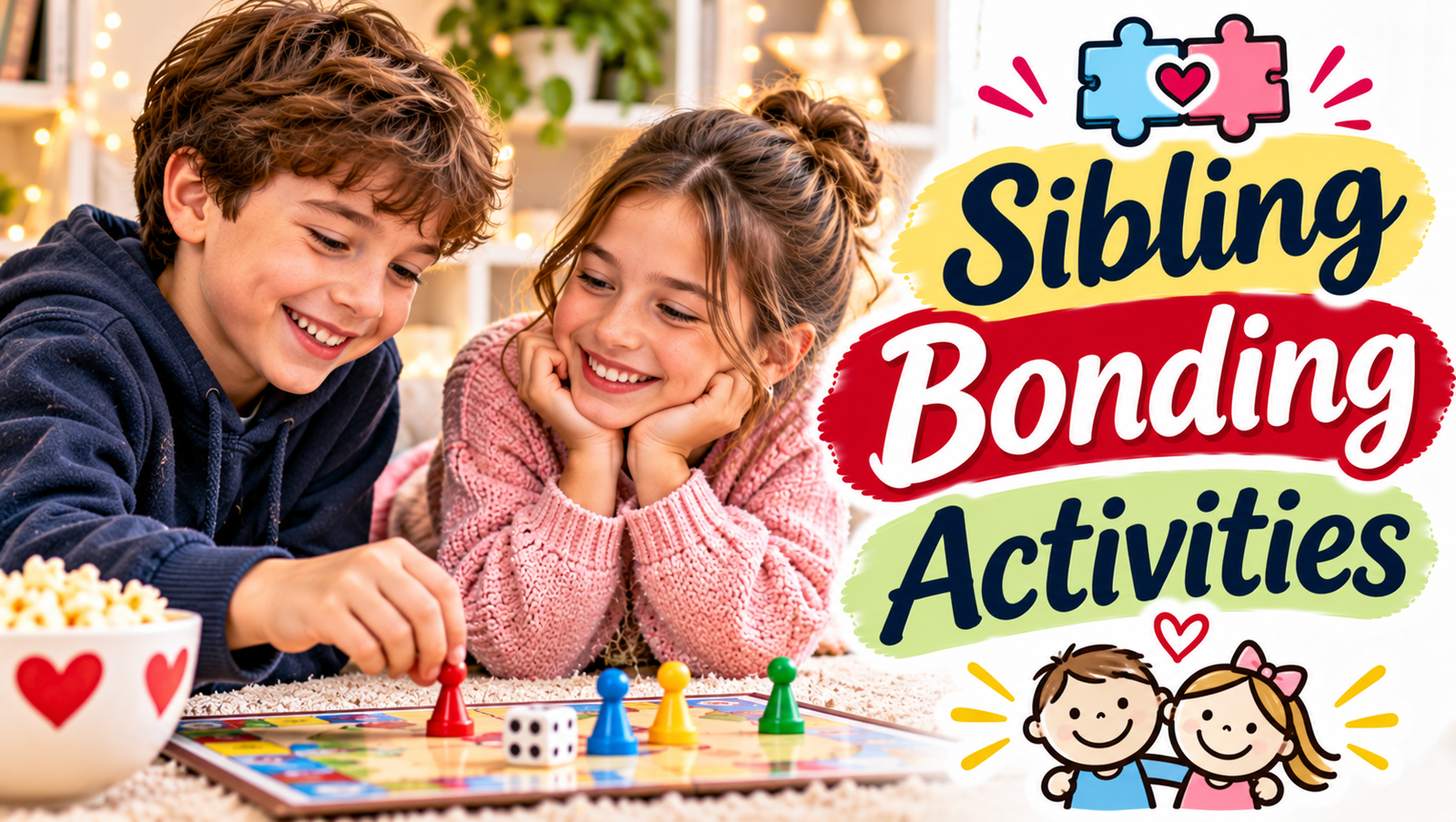
Cooperative board games allow siblings to work toward a shared goal instead of competing for first place.
Choose a game where players solve challenges, collect items, or complete missions together.
Read the instructions as a family and explain how everyone wins or loses as a team.
Encourage children to discuss their moves and help one another.
This is a great option for rainy afternoons or quiet family evenings.
✨ Parenting Tip: Choose games designed for your children’s ages and attention spans. Encourage everyone to share ideas before making group decisions.
Shop cooperative board games for kids on Amazon.


5. Complete a Giant Floor Puzzle Together
A large floor puzzle gives siblings a shared challenge that requires cooperation.
Spread the puzzle pieces across a clean floor or large table.
Ask your children to work together to complete the picture.
One child can find edge pieces while another sorts pieces by color or pattern.
As the picture comes together, they can celebrate each completed section.
✨ Parenting Tip: Choose a puzzle that matches the younger child’s abilities, or give older siblings more challenging sections to keep everyone involved.
Shop large floor puzzles for kids on Amazon.

6. Create a Team Obstacle Course
An obstacle course becomes even more fun when siblings complete it as partners.
Arrange cushions, cones, tunnels, and floor markers in a safe play area.
Challenge your children to move through the course while helping each other.
They might carry a soft ball together, follow matching movements, or complete each obstacle side by side.
The goal is to finish as a team rather than race.
✨ Parenting Tip: Use low, stable obstacles and remove tripping hazards. Let younger children suggest parts of the course so they feel included.
Shop kids indoor obstacle course sets on Amazon.

7. Play Keep-the-Balloon-Up Together
This simple game encourages siblings to communicate and coordinate their movements.
Give your children one inflated balloon and challenge them to keep it from touching the floor.
They can gently tap it back and forth while working together.
For an extra challenge, ask them to count how many taps their team completes.
Try adding a second balloon when they’re ready for a harder activity.
✨ Parenting Tip: Use a lightweight beach ball instead of a balloon for younger children. Deflated or broken balloons are choking hazards and require careful adult supervision.
Shop lightweight beach balls for kids on Amazon.

8. Build a LEGO City Together
Building a miniature city encourages siblings to combine their creativity and problem-solving skills.
Provide age-appropriate building bricks and a large building surface.
Ask your children to design a city with houses, roads, parks, and shops.
One child might build the buildings while another creates roads and outdoor spaces.
Encourage them to connect their creations into one shared project.
✨ Parenting Tip: Help siblings agree on a simple plan before building. Use larger bricks for younger children who may still put small objects in their mouths.
Shop kids building brick sets on Amazon.

9. Go on a Team Treasure Hunt
A treasure hunt turns teamwork into an exciting mission.
Hide a small prize, favorite book, or family activity card somewhere in the house.
Create clues that lead siblings from one location to another.
Ask them to solve each clue together before moving forward.
The final reward should be something everyone can enjoy.
✨ Parenting Tip: Include picture clues for younger children and simple riddles for older siblings so both can participate meaningfully.
Shop treasure hunt clue cards for kids on Amazon.

10. Create a Collaborative Art Masterpiece
A shared art project encourages siblings to express their ideas while creating something together.
Spread a large sheet of paper across a table or the floor.
Provide washable markers, crayons, stickers, and colored pencils.
Choose a theme such as an underwater world, magical garden, or dream playground.
Ask your children to add different parts of the same picture.
✨ Parenting Tip: Encourage children to ask before drawing over someone else’s artwork. This helps them practice respecting boundaries while collaborating.
Shop large paper rolls for kids crafts on Amazon.

11. Play a Partner Bean Bag Toss
Turn a traditional bean bag toss into a cooperative challenge.
Set up a target on the floor or in the backyard.
Ask siblings to work together to land a certain number of bean bags inside the target.
Instead of keeping individual scores, combine their successful throws.
They can adjust the distance and help each other improve.
✨ Parenting Tip: Celebrate encouragement and teamwork as much as successful throws. Move the target closer for younger children.
Shop kids bean bag toss games on Amazon.

12. Build a Marble Run as a Team
A marble run building challenge encourages siblings to experiment, plan, and solve problems.
Provide an age-appropriate marble run set and ask your children to create one connected track.
They can take turns adding sections and testing how the ball moves through the course.
If a section doesn’t work, encourage them to troubleshoot together.
The shared goal is to create a working track from start to finish.
✨ Parenting Tip: Traditional marbles are choking hazards for young children. Use large-ball toddler-safe alternatives when appropriate and follow the toy’s age recommendations.
Shop marble run building sets for kids on Amazon.

13. Play a Cooperative Storytelling Game
Storytelling games help siblings practice listening, imagination, and taking turns.
Start with a simple sentence such as, “One morning, two explorers found a mysterious map.”
Ask one child to add the next sentence.
The other sibling continues the story, and they keep building the adventure together.
Use picture cards or storytelling dice if they need inspiration.
✨ Parenting Tip: Encourage children to build on each other’s ideas rather than correcting or rejecting them. Silly stories are welcome!
Shop storytelling dice for kids on Amazon.

14. Complete a Team Rescue Mission
Turn ordinary toys into an imaginative rescue adventure.
Place stuffed animals around a room and pretend they need help getting home.
Give siblings a shared mission to rescue every animal and bring it to a designated safe area.
They can create a rescue plan, assign roles, and work together to complete the challenge.
This activity combines pretend play with teamwork and problem-solving.
✨ Parenting Tip: Let siblings switch roles halfway through the game so everyone gets a chance to lead and help.
Shop stuffed animal toy sets on Amazon.

15. Work Together on a Family Escape Room Challenge
A simple at-home escape room is a fun cooperative activity for older siblings.
Create a series of age-appropriate puzzles, matching games, and hidden clues.
Each solved challenge reveals the next step.
The siblings must communicate, share ideas, and work together to complete the final mission.
Use a themed story, such as finding a missing treasure or solving a mystery.
✨ Parenting Tip: Avoid actually locking children inside a room. Create an imaginary escape mission with safe, accessible spaces and clues suited to their ages.
Shop escape room games for kids on Amazon.

Best Cooperative Games for Siblings by Age
Choosing the right game helps children participate comfortably, especially when siblings have different abilities.
| Cooperative Game | Suggested Age Range | Skills Practiced |
|---|---|---|
| Blanket fort building | 3+ | Creativity, communication |
| Team scavenger hunt | 3+ | Observation, teamwork |
| Block tower challenge | 3+ | Problem-solving, patience |
| Cooperative board games | Varies by game | Turn-taking, collaboration |
| Giant floor puzzle | 3+ | Matching, cooperation |
| Team obstacle course | 3+ | Coordination, teamwork |
| Keep-the-ball-up game | 3+ with a suitable ball | Communication, coordination |
| Building brick city | Varies by set | Planning, creativity |
| Team treasure hunt | 4+ | Problem-solving, cooperation |
| Collaborative art | 3+ | Sharing, creativity |
| Partner bean bag toss | 3+ | Encouragement, coordination |
| Marble run challenge | Varies by set | Engineering, problem-solving |
| Cooperative storytelling | 4+ | Listening, imagination |
| Team rescue mission | 3+ | Pretend play, teamwork |
| Family escape room | 6+ | Reasoning, communication |
Age ranges are general activity suggestions, not toy safety ratings. Always follow the manufacturer’s recommended ages and supervise activities according to your children’s abilities.
How to Make Cooperative Games Fun for Different-Age Siblings
When siblings have an age gap, choosing games that feel fair to everyone can be challenging.
These simple adjustments can help.
- Give everyone a meaningful role. Older children can read instructions while younger siblings search for objects or sort materials.
- Choose shared goals. Make the objective something the siblings accomplish together.
- Adjust the difficulty. Include easier and harder tasks within the same game.
- Avoid unnecessary competition. Focus on completing the challenge rather than comparing individual performance.
- Encourage turn-taking. Make sure every child has opportunities to make decisions.
- Keep activities short. Younger children may enjoy 10–15 minutes of play before needing a break.
- Celebrate teamwork. Praise specific examples of listening, helping, and sharing.
- Let siblings choose together. Offer two or three game options and encourage them to agree on one.
Benefits of Cooperative Games for Siblings
Cooperative games create opportunities for children to practice important social and emotional skills.
- Teamwork: Siblings learn to work toward a shared objective.
- Communication: Children practice explaining ideas and listening to one another.
- Problem-solving: Shared challenges encourage brainstorming and experimentation.
- Patience: Taking turns helps children practice waiting and cooperating.
- Empathy: Children have opportunities to recognize when someone needs help.
- Conflict resolution: Small disagreements become chances to practice compromise.
- Confidence: Every child can contribute to a successful team effort.
- Creativity: Collaborative games encourage children to combine their ideas.
- Sibling connection: Enjoyable shared experiences can help strengthen family relationships.
These benefits develop gradually, and disagreements are still a normal part of sibling play.
Tips for Encouraging Siblings to Work Together
A few simple parenting strategies can make cooperative play more enjoyable.
- Start with easy challenges: Choose games your children can complete successfully together.
- Explain the shared goal: Remind siblings that they’re on the same team.
- Avoid comparing children: Focus on each child’s contribution rather than individual ability.
- Model helpful language: Encourage phrases like “What do you think?” and “Let’s try together.”
- Rotate responsibilities: Give everyone opportunities to lead and support.
- Allow creative solutions: Children may discover different ways to complete a challenge.
- Step in when necessary: Help children resolve disagreements without taking over the entire activity.
- Respect personal boundaries: Don’t force siblings to share every toy or participate when they need a break.
- Praise specific teamwork: Notice when children listen, compromise, or help each other.
- Keep it enjoyable: End the game or take a break if frustration begins to outweigh the fun.
Final Thoughts
Sibling play doesn’t always have to involve winning, losing, or competing for attention. 💕
These 15 cooperative games for siblings to play on the same team offer fun ways for children to collaborate, communicate, and enjoy shared adventures.
Whether your kids build a blanket fort, complete a treasure hunt, create a giant puzzle, or solve an escape room challenge, the goal is to help them enjoy working together.
Start with a simple activity that matches their ages and interests, and gradually introduce more challenging team games.
With a little encouragement and plenty of opportunities to cooperate, siblings can create wonderful memories while learning how to support each other! ✨