This Post Contains Affiliate Links. Please Read Our Disclosure for Full Information.
Want to keep your preschooler busy while helping little hands develop important skills? ✂️💛 These 25 fine motor activities for preschoolers use simple supplies you probably already have at home.
From playdough creations to paper crafts and sorting games, these easy activities make learning feel like playtime!
1. Playdough Rolling and Pinching
Playdough is one of the easiest ways to encourage fine motor development through play.
Give your preschooler a small amount of playdough and encourage them to roll snakes, pinch tiny pieces, flatten circles, and create pretend cookies.
These movements give children opportunities to practice finger strength and hand coordination.
✨ Parenting Tip: Ask your child to make different shapes, letters, or pretend foods to add creativity to the activity.
Explore non-toxic playdough sets for preschoolers.

2. Clothespin Color Matching
Turn ordinary clothespins into a fun preschool learning activity.
Draw colored circles on a piece of cardboard and provide matching colored clothespins.
Ask your child to clip each clothespin onto the correct color.
Opening and closing clothespins gives little fingers practice with controlled gripping movements.
✨ Parenting Tip: Start with easy-to-squeeze clothespins and gradually introduce firmer ones as your child becomes more comfortable.
Explore wooden clothespins for kids crafts.

3. Paper Tearing and Collage Making
Sometimes the simplest activities are the most entertaining!
Give your preschooler colorful paper and encourage them to tear it into small pieces.
Then let them glue the pieces onto a larger sheet to create a rainbow, flower, or abstract picture.
Tearing paper involves coordinated finger movements while allowing plenty of creativity.
✨ Parenting Tip: Use thinner paper for beginners because it’s easier for little hands to tear.
Explore colorful construction paper for kids.


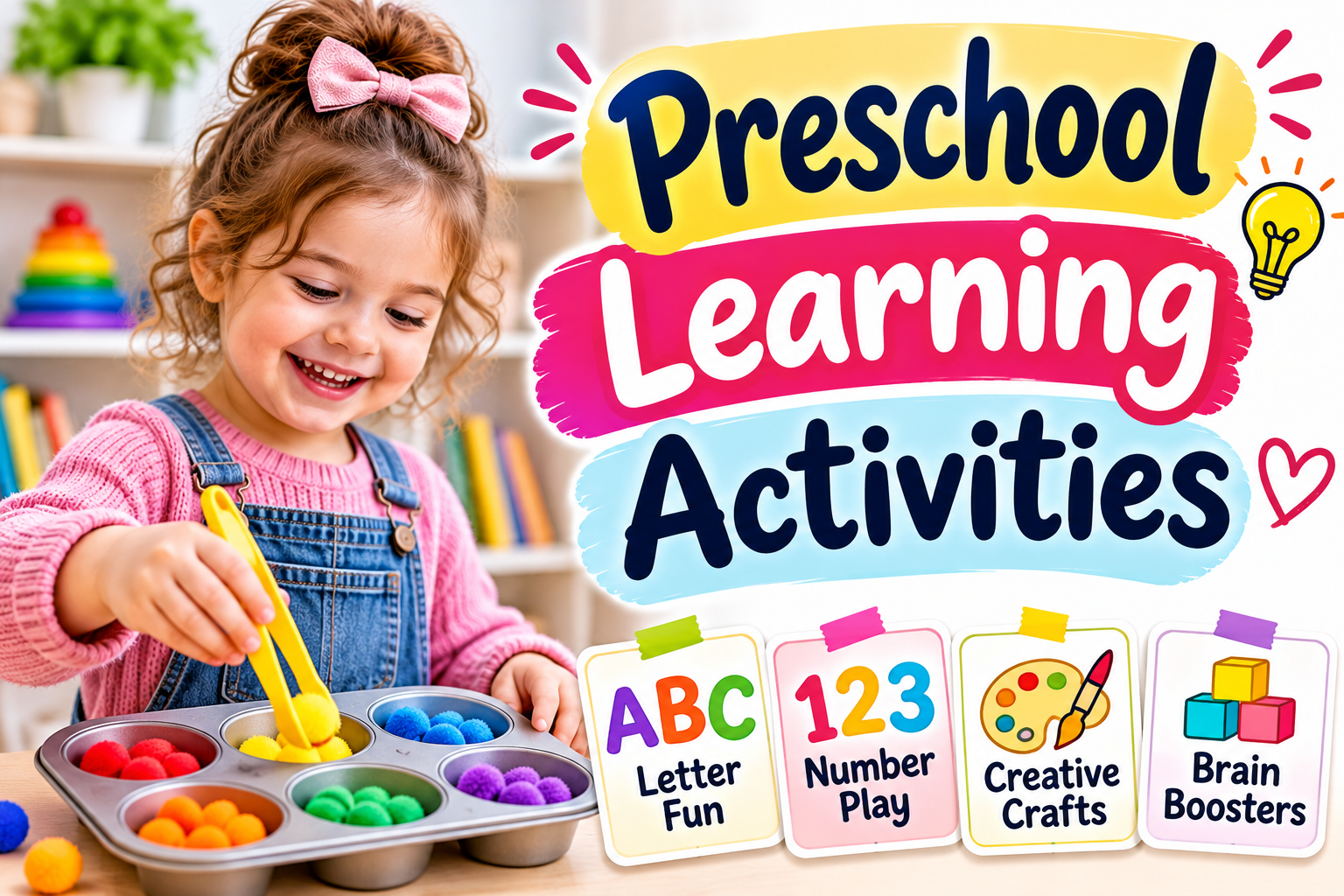
4. Pom-Pom Sorting With Tongs
Create a colorful sorting game using pom-poms and small bowls.
Place large craft pom-poms on a tray and ask your preschooler to transfer them into different containers using child-friendly tongs.
They can sort by color, size, or whatever silly categories they invent.
✨ Parenting Tip: Choose age-appropriate, larger pom-poms and supervise closely because small craft pieces can be choking hazards.
Explore preschool fine motor sorting tongs.

5. Sticker Peeling and Decorating
Preschoolers absolutely love stickers, and they’re surprisingly useful for practicing finger coordination.
Give your child a sheet of large stickers and let them peel each one off independently.
They can decorate paper, create pictures, or place stickers inside drawn shapes.
✨ Parenting Tip: Start by lifting one corner of each sticker if your child finds peeling difficult.
Explore large preschool sticker activity books.

6. Pasta Threading With String
Pasta threading is a simple activity that encourages hand-eye coordination.
Provide large, dry pasta tubes and a thick shoelace with a firm plastic tip.
Show your preschooler how to thread the pasta onto the lace to create a pretend necklace or colorful pattern.
✨ Parenting Tip: Use large pasta pieces, supervise the activity, and avoid letting children wear long strings around their necks.
Explore preschool lacing and threading sets.

7. Water Transfer With a Sponge
This easy water activity is perfect for preschoolers who enjoy sensory play.
Fill one shallow bowl with a small amount of water and leave another bowl empty.
Give your child a clean sponge and ask them to soak up water, carry it across the tray, and squeeze it into the second bowl.
✨ Parenting Tip: Use only a small amount of water, supervise throughout, and place a towel underneath to catch spills.
Explore kid-friendly sponge activity supplies.

8. Preschool Scissor Cutting Practice
Learning to use scissors is an important preschool skill that takes practice.
Draw thick straight lines, zigzags, or simple shapes on paper.
Give your child age-appropriate safety scissors and encourage them to cut along the lines.
Start with short strips before introducing more complicated shapes.
✨ Parenting Tip: Demonstrate safe scissor handling and always supervise cutting activities.
Explore preschool safety scissors.

9. Build Towers With Small Blocks
Building towers gives preschoolers opportunities to practice grasping, positioning, and balancing objects.
Provide age-appropriate building blocks and encourage your child to stack them into towers, houses, or pretend castles.
Let them experiment with different arrangements and rebuild when their creations tumble.
✨ Parenting Tip: Start with larger blocks and introduce smaller, age-appropriate pieces as coordination improves.
Explore preschool wooden building blocks.

10. Cotton Ball Transfer With a Spoon
Turn a simple household task into a playful fine motor challenge.
Place cotton balls in one bowl and give your preschooler a spoon.
Ask them to transfer the cotton balls into another container without dropping them.
You can turn it into a pretend cooking game for extra fun.
✨ Parenting Tip: Start with a large spoon and gradually introduce smaller spoons as your child becomes more confident.
Explore child-sized learning spoons.

11. Button Sorting by Color and Size
Sorting activities can combine fine motor practice with early math concepts.
Provide a small collection of large, age-appropriate buttons and ask your preschooler to group them by color, shape, or size.
Use muffin tin compartments or small bowls to organize the groups.
✨ Parenting Tip: Avoid tiny buttons and supervise closely, as loose buttons can pose choking hazards.
Explore large preschool sorting buttons.

12. Build Shapes With Craft Sticks
Craft sticks are affordable and perfect for hands-on preschool activities.
Give your child a few large craft sticks and encourage them to arrange triangles, squares, houses, or simple patterns.
They can also build pretend roads and fences for imaginary animals.
✨ Parenting Tip: Draw a shape on paper first and let your preschooler copy it using the sticks.
Explore jumbo craft sticks for kids.

13. Playdough Shape Cutting
Give playdough time a fun new twist with shape cutters.
Roll out a flat piece of playdough and let your preschooler press cookie cutters into it.
They can create stars, hearts, circles, and pretend cookies.
Pressing, lifting, and separating shapes gives children practice coordinating their hands.
✨ Parenting Tip: Use large plastic cutters with smooth edges that are easy for preschoolers to grip.
Explore playdough shape cutter sets.

14. Draw Shapes in a Salt Tray
This simple sensory writing activity requires only a shallow tray and a little salt.
Spread a thin layer of salt across the tray and demonstrate how to draw lines, circles, and simple shapes using one finger.
Your preschooler can shake the tray gently to erase their designs and start again.
✨ Parenting Tip: Supervise closely, discourage tasting, and use a paper-based tracing activity if your child tends to put materials in their mouth.
Explore preschool sensory writing trays.

15. Use a Spray Bottle for Target Practice
A child-friendly spray bottle can turn water play into a fun hand-strengthening activity.
Fill a small spray bottle with plain water and draw large targets on a washable outdoor surface.
Encourage your preschooler to aim and spray each target.
✨ Parenting Tip: Use clean water only, supervise closely, and choose a surface that won’t become slippery.
Explore small spray bottles for kids activities.

16. Make Paper Chains
Paper chains are an easy craft that encourages preschoolers to use both hands together.
Cut colorful paper into strips and show your child how to form loops.
Help them secure each loop with a glue stick or tape before adding the next strip.
They can create decorations for their bedroom or a pretend party.
✨ Parenting Tip: Prepare the paper strips beforehand if your child is still learning to use scissors.
Explore washable glue sticks for preschoolers.

17. Practice Opening and Closing Containers
Preschoolers often enjoy activities that involve everyday objects.
Collect a few clean plastic containers with different lids and let your child practice opening and closing them.
Try screw-top containers, snap-on lids, and small storage boxes.
This activity encourages finger coordination and problem-solving.
✨ Parenting Tip: Choose clean, child-safe containers without sharp edges or small detachable parts.
Explore preschool twist and lock activity toys.

18. Create Pictures With Dot Markers
Dot markers are a fun alternative to traditional coloring.
Draw a simple flower, butterfly, or rainbow outline on paper and let your preschooler fill it with colorful dots.
They can practice controlling where each dot lands while exploring colors and patterns.
✨ Parenting Tip: Choose washable, child-safe dot markers and use large designs for beginners.
Explore washable dot markers for preschoolers.

19. Make Pipe Cleaner Shapes
Pipe cleaners can be used for a variety of simple preschool crafts.
Give your child soft, age-appropriate craft stems and show them how to bend the stems into circles, hearts, and zigzag shapes.
They can also create pretend flowers or silly creatures.
✨ Parenting Tip: Cover or fold sharp wire ends securely and supervise the activity to prevent pokes or scratches.
Explore colorful craft pipe cleaners.

20. Practice Tracing Lines and Shapes
Tracing is a simple way to introduce early pencil control.
Draw thick straight lines, curved paths, circles, and zigzags on paper.
Ask your preschooler to follow the lines using a chunky crayon or washable marker.
Turn the activity into a game by drawing roads for pretend cars or paths through a maze.
✨ Parenting Tip: Begin with large, simple lines before moving on to smaller shapes.
Explore preschool tracing activity books.

21. Build Patterns With Large Beads
Large beads are useful for introducing patterns while practicing hand-eye coordination.
Give your preschooler a few oversized, age-appropriate beads and a thick lacing cord.
Show them how to create simple color patterns such as red-blue-red-blue.
Let them experiment with their own designs too.
✨ Parenting Tip: Use beads specifically designed for your child’s age and supervise closely. Keep loose beads and cords away from younger siblings.
Explore large preschool lacing beads.

22. Use Tweezers to Pick Up Small Objects
Child-friendly tweezers make ordinary sorting activities feel like a fun challenge.
Place large foam shapes or other age-appropriate objects on a tray and encourage your preschooler to pick them up using tweezers.
They can transfer the pieces into small bowls or sort them by color.
✨ Parenting Tip: Start with easy-to-grip objects and child-safe tweezers before introducing more challenging materials.
Explore preschool fine motor tweezers.
23. Make a DIY Cardboard Lacing Board
Turn a piece of cardboard into a reusable fine motor activity.
Cut a large shape from sturdy cardboard and punch holes around the edges.
Give your preschooler a thick shoelace and demonstrate how to thread it through the holes.
They can practice moving the lace in and out to create different patterns.
✨ Parenting Tip: Prepare the holes yourself and use a short lace with no loose knots or small attachments.
Explore preschool lacing activity cards.

24. Create a Mini Sticker Pattern Game
Turn sticker time into a simple pattern-building challenge.
Draw a row of large circles on paper and provide two colors of stickers.
Start a pattern like red-blue-red-blue and encourage your preschooler to continue it.
You can also make silly patterns using animal or shape stickers.
✨ Parenting Tip: Begin with two-color patterns before introducing more complicated sequences.
Explore preschool pattern sticker activity books.

25. Create a Fine Motor Activity Tray
Can’t decide which activity to try? Create a simple fine motor activity tray!
Place a few age-appropriate supplies on a tray, such as playdough, large stickers, chunky crayons, and clothespins.
Let your preschooler choose an activity and explore at their own pace.
Rotate the materials every few days to keep things interesting.
✨ Parenting Tip: Offer only two or three activities at a time to avoid overwhelming your child.
Explore preschool fine motor activity kits.

Best Fine Motor Activities for Different Preschool Skills
Fine motor activities give children opportunities to practice different hand movements while playing.
| Skill | Best Activities |
|---|---|
| Finger strength | Playdough pinching, clothespin matching |
| Hand-eye coordination | Pasta threading, bead patterns |
| Pencil control | Tracing, salt tray drawing |
| Scissor skills | Paper cutting, paper chains |
| Grasping and releasing | Pom-pom sorting, cotton ball transfer |
| Using both hands together | Cardboard lacing, opening containers |
| Finger precision | Sticker peeling, tweezers |
| Creativity | Paper collages, craft stick shapes |
| Early math concepts | Button sorting, sticker patterns |
Quick Tip: Children develop fine motor skills at different rates. Focus on enjoyable, age-appropriate practice rather than perfect results.
Easy 15-Minute Fine Motor Activity Routine
Need a quick preschool activity plan for a busy morning?
Try this simple routine:
| Time | Activity |
|---|---|
| 3 minutes | Playdough rolling and pinching |
| 3 minutes | Sticker peeling and decorating |
| 3 minutes | Clothespin color matching |
| 3 minutes | Drawing or tracing shapes |
| 3 minutes | Paper tearing and collage making |
You can adjust the activities based on your child’s interests and attention span.
There’s no need to complete every activity if your preschooler would rather spend longer exploring one favorite.
7 Tips for Making Fine Motor Activities More Fun
A few simple changes can make fine motor practice more enjoyable for preschoolers.
- Start with easy activities. Choose movements your child can attempt comfortably.
- Use everyday supplies. Paper, crayons, playdough, and clothespins are great starting points.
- Follow your child’s interests. Turn activities into animals, vehicles, flowers, or favorite characters.
- Keep sessions short. Five to fifteen minutes may be plenty, depending on your child.
- Celebrate effort. Focus on participation rather than perfect results.
- Offer choices. Let your preschooler pick between two or three activities.
- Supervise carefully. Choose age-appropriate materials and keep choking hazards away from younger children.
The goal is to help your child enjoy using their hands while exploring and creating.
Frequently Asked Questions About Fine Motor Activities for Preschoolers
What are fine motor skills in preschoolers?
Fine motor skills involve using the small muscles of the hands and fingers, often together with visual coordination.
Children use these skills for drawing, building, dressing, eating, and other everyday tasks.
What are the easiest fine motor activities for preschoolers?
Playdough, sticker peeling, paper tearing, drawing, and stacking blocks are simple activities that require very little preparation.
How can I improve my preschooler’s fine motor skills at home?
Offer regular opportunities for hands-on play, such as coloring, building, using playdough, threading age-appropriate materials, and practicing everyday self-care tasks.
Are fine motor activities important for handwriting?
Fine motor activities can support hand control and coordination used in early writing.
However, handwriting also involves visual-motor skills, posture, instruction, and practice with age-appropriate drawing and writing tools.
How long should preschoolers practice fine motor activities?
There isn’t one required session length.
Short, enjoyable activities are often more practical than long sessions. Follow your child’s interest, comfort, and attention span.
What supplies do I need for fine motor activities?
Common supplies include paper, crayons, playdough, clothespins, stickers, child-safe scissors, and age-appropriate building blocks.
You don’t need expensive educational toys to get started.
What if my preschooler struggles with fine motor activities?
Try larger materials, simpler movements, and activities that match your child’s current abilities.
If difficulties persist or interfere with everyday tasks, consider discussing your concerns with your child’s pediatrician or an occupational therapist.
Final Thoughts
Helping your preschooler practice fine motor skills doesn’t have to involve expensive toys or complicated learning activities. 💛
These 25 fine motor activities for preschoolers using simple supplies show how everyday materials can become fun opportunities for hands-on learning.
From playdough and stickers to threading games and paper crafts, there are plenty of creative ways to keep little hands busy.
Start with a few activities your child enjoys, keep the experience playful, and celebrate every little accomplishment.
Because sometimes, the simplest activities create the biggest smiles! 🥹✨
Save these fine motor activities for preschoolers to your Pinterest Preschool Learning Activities board so you’ll always have easy, budget-friendly ideas ready for your next learning session.
Happy learning and playing together!